
What if your first aid certificate does not actually expire, but your employer is legally required to treat it as if it has? It is a common source of frustration for workers across Australia who find themselves staring at a qualification and wondering exactly how long does first aid certificate last before they are no longer compliant. While the Statement of Attainment itself technically remains valid, the industry standards for workplace health and safety (WHS) dictate a strict schedule for maintaining “currency” rather than just “validity”.
We know how difficult it is to track separate dates for CPR and general first aid while trying to manage a busy work schedule. You deserve the peace of mind that comes with knowing your life-saving skills are sharp and your business meets its legal duty of care. This 2026 guide provides the exact renewal timelines you need to stay current. We will break down the differences between HLTAID011 and annual CPR refreshers, as well as specialised units for the education and electrical sectors, so you can stay organised and ready for any emergency.
Key Takeaways
- For most Australian workplaces, the standard HLTAID011 Provide First Aid unit is valid for three years from the date of issue.
- You must refresh your CPR component (HLTAID009) every 12 months to remain compliant with Australian Resuscitation Council guidelines and workplace health and safety laws.
- To accurately determine how long does first aid certificate last for your specific role, you must check the unit code on your Statement of Attainment against industry requirements like ACECQA for childcare.
- Regular training is essential to combat “skill fade,” as clinical research shows that life-saving CPR techniques and AED proficiency begin to decline just six months after your last course.
- Ensure you verify your specific renewal needs, whether you require advanced resuscitation units or industry-specific training like rescue from a live low voltage panel.
The Australian Standard: How Long is First Aid Valid?
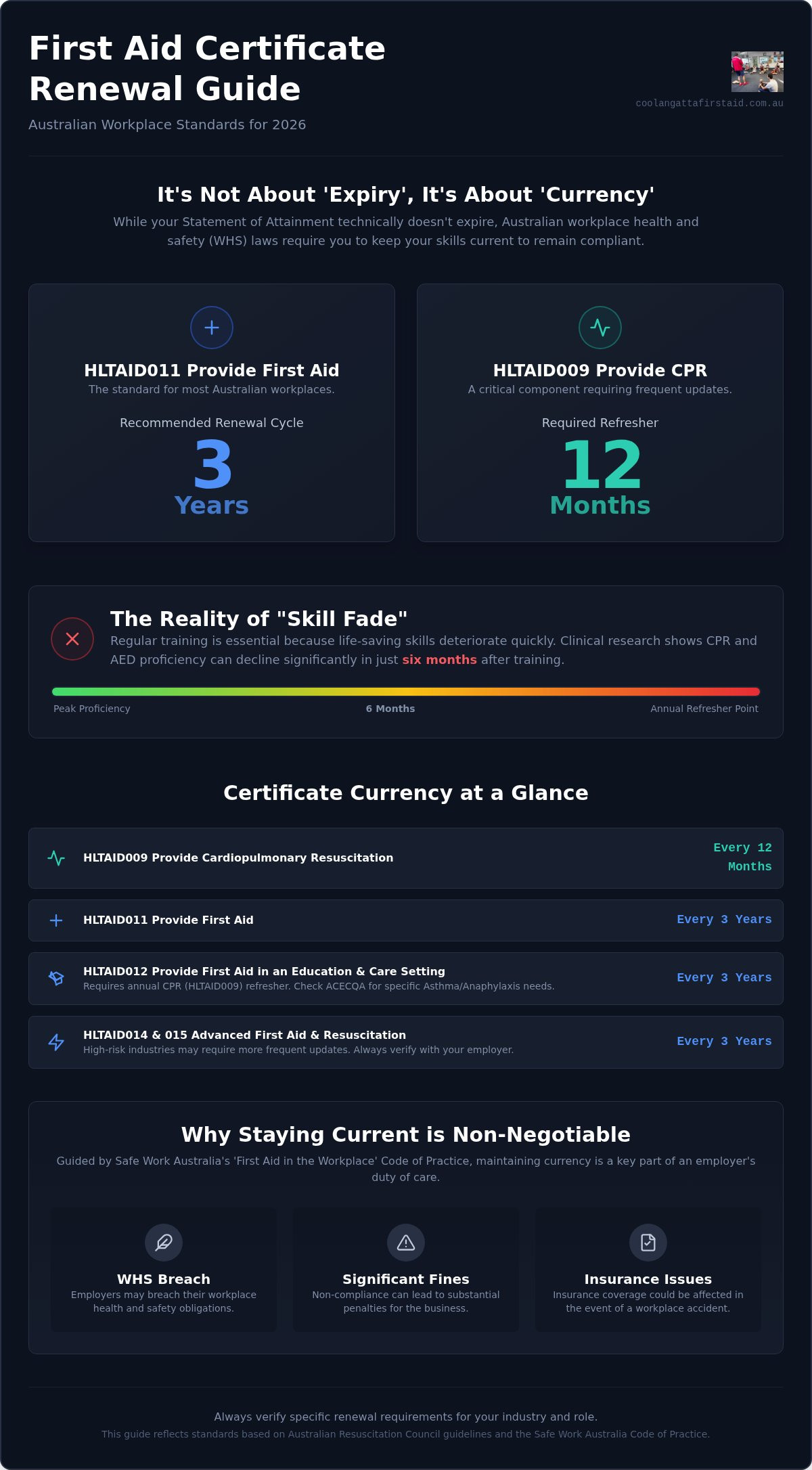
In Australia, the timeline for your certification depends entirely on the specific unit code you hold. If you have recently completed a course, you might be asking how long does first aid certificate last in a professional capacity. While the foundational knowledge of What is First Aid? remains constant, the clinical guidelines updated by the Australian Resuscitation Council (ARC) suggest that skills need regular refreshing. For the standard HLTAID011 Provide First Aid unit, the accepted industry interval is three years. However, the CPR component, HLTAID009, carries a much shorter window of just 12 months.
This distinction exists because the ARC recognises that high-intensity skills like chest compressions and rescue breathing are the first to deteriorate. While you might remember how to bandage a minor cut for years, the muscle memory required for effective resuscitation fades quickly. To maintain compliance, you don’t necessarily need to sit the full first aid course every year; you can simply complete a standalone HLTAID009 Provide cardiopulmonary resuscitation refresher to keep your currency up to date between your three-year first aid cycles.
Accredited Units vs. Non-Accredited Workshops
Nationally recognised units like HLTAID011 and HLTAID009 are part of the Australian Vocational Education and Training (VET) sector. When you complete these, you receive a Statement of Attainment. Unlike a simple workshop attendance certificate, these units are mapped to specific national standards. In the context of Australian First Aid standards, currency refers to the period during which a certificate holder is deemed to have maintained the practical skills and theoretical knowledge required to perform first aid safely and effectively. Without this accredited “attainment” on your record, many employers cannot legally recognise your training for workplace compliance. If you are unsure whether your provider meets the required standard, our guide to finding an accredited first aid course Gold Coast workers can rely on explains exactly how to verify an RTO’s status and which unit codes apply to your industry.
Safe Work Australia and the Code of Practice
Safe Work Australia provides the “First Aid in the Workplace” Code of Practice, which serves as the primary benchmark for businesses across the country. While the code isn’t a law in itself, it’s the standard used by courts and regulators to determine if an employer has met their duty of care under workplace health and safety (WHS) legislation. The code explicitly recommends the three-year and one-year renewal cycles mentioned above.
Letting your certification lapse can have serious professional consequences. Beyond the risk of being unable to provide life-saving care, an expired certificate means your employer may be in breach of their WHS obligations. This can lead to significant fines for the business and may even affect insurance coverage in the event of a workplace accident. Staying on top of your renewal dates ensures you remain a qualified asset to your team and stay on the right side of Australian regulations.
Validity Breakdown by Certificate Unit Code
Understanding exactly how long does first aid certificate last requires looking beyond the general three-year rule. In the Australian Vocational Education and Training (VET) sector, each unit of competency carries its own specific recommendation for currency. While a Statement of Attainment doesn’t have a hard expiry date, the Model Code of Practice: First Aid in the Workplace provides the clear standard that most employers follow to ensure safety and compliance.
- HLTAID009 Provide cardiopulmonary resuscitation: This unit must be renewed every 12 months. It’s the most frequent refresher required because CPR skills are highly technical and prone to rapid decline.
- HLTAID011 Provide First Aid: The industry standard for most workplaces, this unit is typically renewed every three years.
- HLTAID012 Provide First Aid in an Education and Care Setting: Like the standard first aid unit, this is valid for three years, though childcare workers must still refresh their CPR component annually.
- HLTAID014 & HLTAID015: Advanced first aid and resuscitation units generally follow a three-year cycle, but high-risk industries often demand more frequent training.
Renewal Timelines for General Public vs. Professionals
If you’re a member of the general public learning for personal interest, your timeline is flexible. However, for professionals, the stakes are higher. Educators and childcare providers often need to maintain additional certifications such as 22702VIC (Asthma) and 22578VIC (Anaphylaxis), which are frequently refreshed alongside their main first aid unit. Many workplaces require these specific units to meet ACECQA requirements. If you’re unsure which unit your industry demands, you can explore our course options to find the right fit for your role.
Special Case: Low Voltage Rescue (LVR)
Electrical workers, often referred to as sparkies, face unique regulatory requirements. The unit UETDRMP018 Perform rescue from a live low voltage panel is a mandatory requirement for many electrical licences and must be refreshed every 12 months. Because LVR is almost always performed in conjunction with CPR, these two units are typically grouped together in a single annual training session. State-based electrical safety regulators are very strict about this timeframe; letting your LVR currency lapse can result in being unable to legally work on-site until a refresher is completed.
Industry-Specific Requirements for First Aid Renewal
While the general guidelines provide a baseline, your specific profession often dictates a much stricter schedule. Determining how long does first aid certificate last depends heavily on the regulatory body governing your industry. For example, a retail worker and a high-voltage electrician might hold the same CPR unit, but the consequences of a lapsed certificate are vastly different for their respective professional licences. In many sectors, “industry currency” is the metric that matters most for your annual performance reviews and insurance compliance.
In high-risk environments like construction sites or manufacturing plants, Safe Work Australia recommends a higher ratio of first aiders to workers. For these settings, the standard is one first aider for every 25 workers. Because the risk of severe trauma is higher, many site managers implement internal policies requiring annual refreshers for all components, not just CPR. This ensures that the team is always prepared for the specific hazards of their site, such as crush injuries or falls from heights.
ACECQA Standards for Childcare Workers
Early childhood educators must meet the stringent requirements set by the Australian Children’s Education and Care Quality Authority (ACECQA). For these professionals, HLTAID012 Provide First Aid in an Education and Care Setting is the mandatory standard. While this unit technically follows the three-year renewal cycle, the CPR component must be refreshed every 12 months without exception. Additionally, educators must maintain current training in anaphylaxis and asthma management.
The specific Victorian units, 22578VIC (Anaphylaxis) and 22702VIC (Asthma), are widely recognised as the benchmark for these skills. In the childcare sector, having at least one staff member with these current qualifications on-site at all times is a legal requirement. If your certification lapses by even a single day, you may be legally unable to count towards the required staff-to-child ratios, which can disrupt the entire centre’s operations.
Electrical and High-Risk Professional Standards
For those in the electrical trades, the unit UETDRMP018 Perform rescue from a live low voltage panel is a non-negotiable annual requirement. This is often paired with HLTAID009 because a low voltage rescue (LVR) scenario almost always involves a victim who requires immediate resuscitation. Sparkies must stay on top of this 12-month cycle to maintain their electrical licence and meet site entry requirements.
Healthcare professionals, including nurses and aged care workers, also face high expectations. Most nursing boards and healthcare employers require an annual Statement of Attainment for CPR to meet AHPRA standards. Even if your first aid unit is technically valid, your employer’s internal auditing process will likely flag you as non-compliant if your CPR refresher is older than 12 months. Staying proactive with these dates is essential for anyone working in a clinical or high-risk setting.
The Science of Skill Fade: Why Refreshing Matters
Similarly, those in the transport and logistics industry must adhere to strict safety protocols to maintain site compliance. If you are looking to enter this field or upgrade your heavy vehicle skills, you can check out Right Way Transport Training for professional driver instruction in Western Australia.
While we’ve established the regulatory timelines, the “why” behind these intervals is rooted in human biology. Clinical research shows that first aid skills, particularly CPR, begin to deteriorate significantly as early as six months after training. This phenomenon, known as “skill fade,” is the reason why asking how long does first aid certificate last isn’t just a question of compliance. It’s a question of whether you can actually save a life when the pressure is on. High-intensity skills require regular repetition to stay sharp in your long-term memory. If you are based in the region and want to address this skills gap, first aid training in Tweed Heads South offers nationally recognised courses designed to rebuild that muscle memory and keep your certification current.
Medical protocols aren’t static, and neither is the technology we use to treat patients. Automated External Defibrillators (AEDs) are becoming more advanced, and clinical updates from the Australian Resuscitation Council (ARC) ensure that we are always using the most effective techniques. For example, a sudden cardiac arrest victim’s survival rate can increase to as high as 90% if a defibrillator is used within the first minute. However, if you haven’t touched a trainer AED in three years, those precious seconds might be lost to hesitation or confusion over the latest prompts.
Staying Current with ARC Guidelines
Resuscitation protocols evolve based on global medical research. The ARC regularly reviews these standards to refine everything from compression-to-breath ratios to the specific management of snake bites and severe allergic reactions. Using outdated techniques in a real-life emergency isn’t just ineffective; it can be dangerous. For instance, the way we manage Victorian asthma or anaphylaxis cases has been refined over the years to prioritise faster, more reliable interventions. Regular training ensures you aren’t relying on “old-school” methods that have since been superseded by better clinical evidence.
The Confidence Gap
There is a massive difference between knowing a fact and being able to perform a skill under stress. When adrenaline kicks in, the “bystander effect” often takes over, where people hesitate because they aren’t 100% sure of their abilities. Research shows a direct link between training recency and the likelihood of a first aider taking effective action. A refresher course provides a low-pressure environment to reset your muscle memory, ensuring that your response is automatic rather than hesitant. Don’t wait for your skills to disappear. Book your HLTAID009 or HLTAID011 refresher course today to ensure you have the confidence to act when it matters most.
Case studies in Australian workplaces show that teams with current, regularly refreshed certifications have a much higher success rate in reducing the severity of injuries. When first aiders are confident, they apply pressure to wounds faster, use AEDs more correctly, and communicate more effectively with emergency services. This reduces recovery times and, most importantly, saves lives.
How to Renew Your Certification in 2026
Renewing your qualification in 2026 is a streamlined process, but it requires a bit of preparation to ensure you don’t end up with a gap in your compliance. The first step is to locate your most recent Statement of Attainment and check the issue date. Since you now know exactly how long does first aid certificate last for your specific industry, you can work backwards from that date to book your training. It’s best to schedule your refresher at least a month before your current currency lapses to account for busy training schedules and processing times.
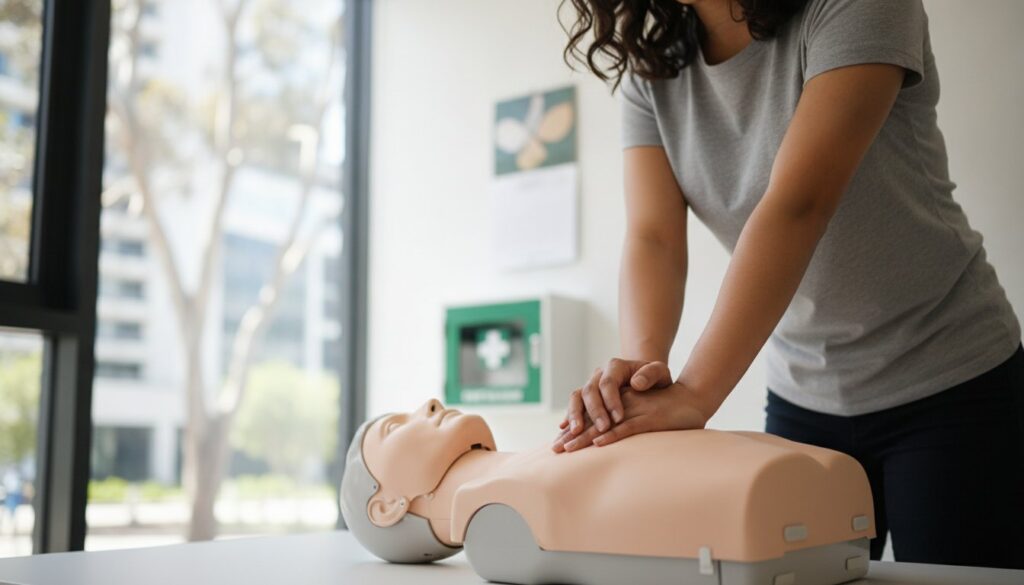
Once you’ve identified the specific unit code you need, such as HLTAID011 or the annual HLTAID009 refresher, you must ensure your Unique Student Identifier (USI) is active. Every student in Australia needs this 10-digit number for nationally recognised training. Without it, your training provider cannot legally issue your certificate. After booking with a reputable provider, you’ll typically complete a theory component followed by a face-to-face practical assessment where you demonstrate your skills on a manikin.
Choosing the Right Refresher Course
In 2026, the most popular way to renew is through a blended learning model. This allows you to complete the bulk of your theory online at your own pace, significantly reducing the time you need to spend in a classroom. A face-to-face session is still mandatory for the practical assessment, as skills like CPR and wound management cannot be assessed through a screen alone. If you’ve been keeping your skills sharp, a shorter refresher session might be available, but many professionals prefer the full course to ensure they are up to date with the latest ARC clinical changes. You can enrol in an accredited first aid course on the Gold Coast to find a schedule that fits your work-life balance and meets the latest 2026 national certification standards.
The USI and Certificate Issuance
The USI registry has made tracking your training history much easier. If you’ve lost your hard copy certificate, you can usually log into your USI account to find a record of your previous attainments. In 2026, most providers issue digital certificates as standard, which are often sent via email within 24 to 48 hours of successfully completing your practical assessment. These digital versions are perfectly acceptable for HR departments and regulatory audits. While you can still request a hard copy, having a digital version on your phone ensures you can prove your compliance instantly while on a job site or at a new centre. If you’re still wondering how long does first aid certificate last after receiving your new one, simply set a calendar reminder for 12 months (for CPR) and three years (for First Aid) from the date of issue.
Stay Compliant and Ready to Save Lives
Maintaining your currency is about more than just checking a box for HR. It’s about ensuring that when an emergency strikes, you have the muscle memory and clinical knowledge to act without hesitation. The answer to how long does first aid certificate last depends on your specific unit, with the three-year standard for HLTAID011 and the essential 12-month refresher for CPR. Whether you’re working in childcare, the electrical trades, or a high-risk office, staying on top of these dates keeps you legally compliant and prepared for the unexpected.
Don’t let your life-saving skills fade into the background. As an RTO 3399 Third Party Provider, we offer Nationally Recognised Training led by expert Australian trainers who focus on practical, real-world application. You can book your nationally recognised First Aid or CPR refresher today to secure your peace of mind and protect those around you. Taking a few hours to refresh your skills today could make all the difference in a crisis tomorrow. You’ve got the power to make a life-saving impact, so stay current and stay confident.
Frequently Asked Questions
Do first aid certificates actually expire in Australia?
Technically, a Statement of Attainment issued in the Australian VET sector never expires. However, its “industry currency” is strictly time-limited. For workplace compliance under the Safe Work Australia Code of Practice, your HLTAID011 unit is only considered current for three years. If you’re wondering how long does first aid certificate last for your job, you must follow these recommended renewal windows to ensure your employer meets their legal duty of care and insurance requirements.
How often do I need to renew my CPR certificate for work?
You must renew your HLTAID009 Provide cardiopulmonary resuscitation certificate every 12 months. This annual requirement is set by the Australian Resuscitation Council (ARC) and is adopted as the standard by Safe Work Australia. Because CPR is a high-intensity skill that is prone to rapid “skill fade,” refreshing every year ensures you can perform high-quality chest compressions and use an AED correctly when a cardiac emergency occurs.
What happens if my first aid certificate has already expired?
If your certification has lapsed beyond the three-year mark, you are no longer considered a qualified first aider for workplace compliance purposes. You won’t face a personal legal penalty, but your employer may be in breach of WHS regulations if they don’t have enough current first aiders on-site. You should book a refresher immediately to regain your currency and ensure you have the confidence to act during a medical crisis or workplace accident.
Is HLTAID011 the same as Senior First Aid?
Yes, HLTAID011 Provide First Aid is the current nationally recognised unit that replaced the older “Senior First Aid” or “Level 2 First Aid” titles. While the name has changed to align with the national training package, it remains the standard requirement for most Australian workplaces. It covers everything from basic life support and CPR to managing trauma, snake bites, and medical emergencies like heart attacks or strokes.
Can I renew my first aid certificate online in 2026?
You can complete the theoretical component of your renewal online through a blended learning model, but you must attend a face-to-face practical assessment. In 2026, fully online courses are not accepted for nationally recognised units like HLTAID011 or HLTAID012. Regulatory bodies like ACECQA specifically require hands-on demonstration of skills, such as performing CPR on a manikin, to ensure you are truly competent in a physical emergency.
Does the 3-year validity apply to childcare first aid (HLTAID012)?
Yes, the HLTAID012 Provide First Aid in an Education and Care Setting certificate is valid for three years. However, you must still refresh the CPR component (HLTAID009) every 12 months to remain compliant with ACECQA and national regulations. Childcare workers must also ensure their asthma (22702VIC) and anaphylaxis (22578VIC) training stays current, as these are critical for maintaining the safety of children in care environments.
How do I find my first aid certificate issue date?
Your issue date is printed clearly on your Statement of Attainment, usually near the bottom or next to the trainer’s signature. If you’ve lost your physical or digital copy, you can log into your Unique Student Identifier (USI) account online. The USI registry keeps a centralised record of all nationally recognised training you’ve completed in Australia, allowing you to verify exactly when your three-year or 12-month window began.
Do I need to do the full course again if I am just renewing?
Most training providers offer a “refresher” or “blended” version of the course for those who already hold a certificate. While you still need to complete the assessment, the training time is often shorter because it focuses on updating your knowledge rather than teaching the basics from scratch. However, if your certificate has been expired for a long period, some providers may recommend the full course to ensure you are up to speed with the latest guidelines.
