
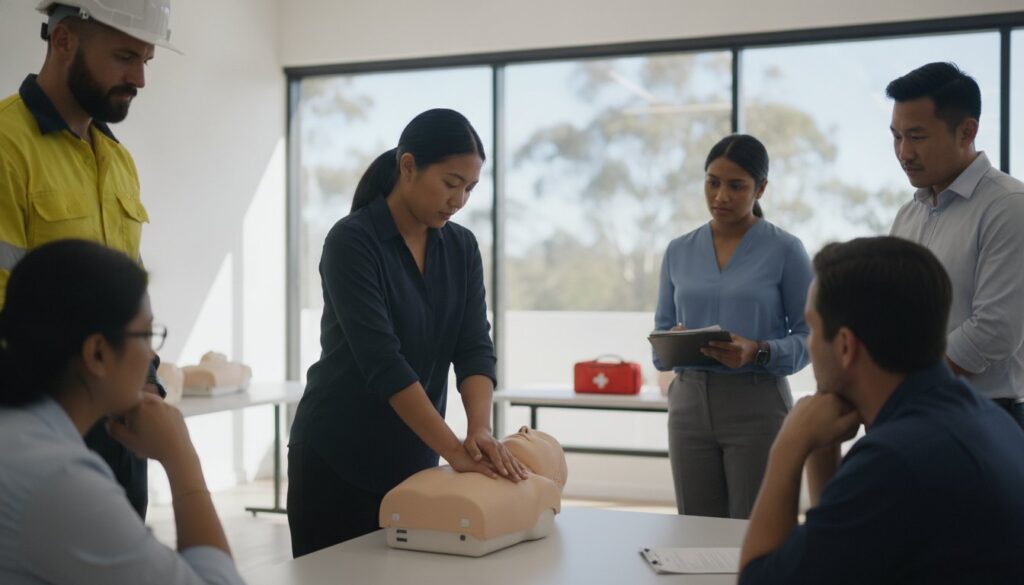
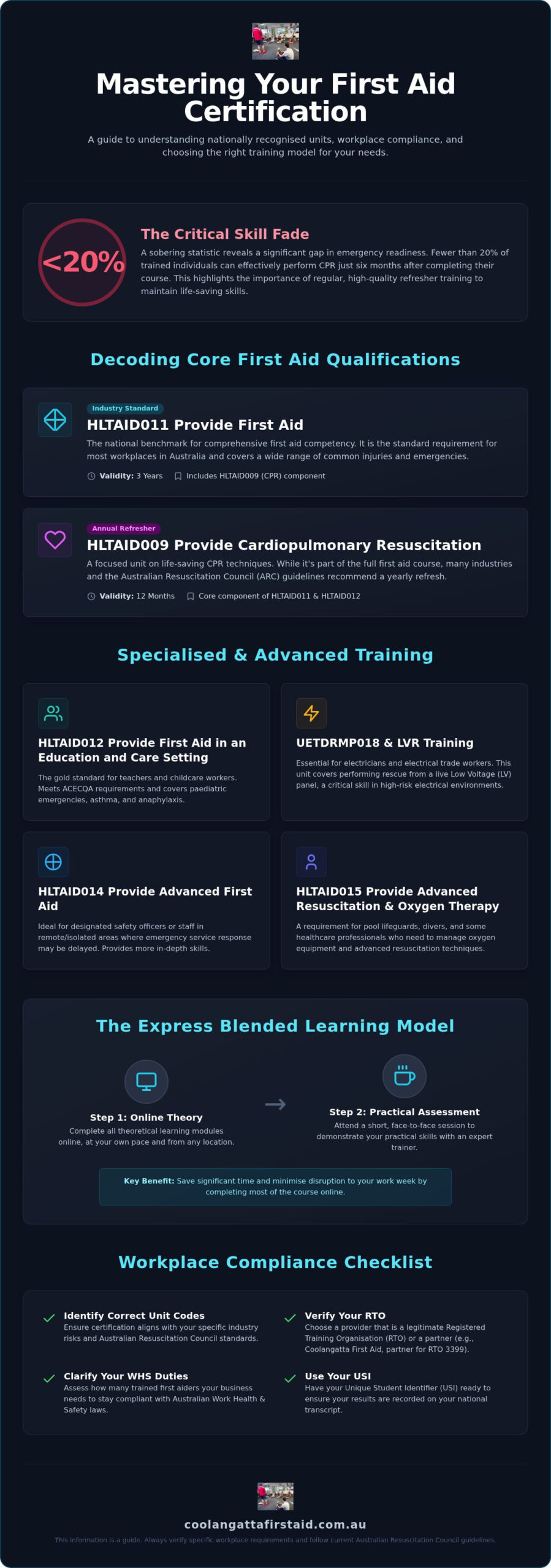
Did you know that fewer than 20% of trained individuals can effectively perform CPR just six months after their initial course? It’s a sobering statistic that highlights why choosing the right nationally recognised first aid training is about more than just ticking a compliance box. At Coolangatta First Aid & CPR Training, we understand that most professionals feel a bit of anxiety when it’s time to renew their qualifications. You might be confused by the difference between HLTAID011 and HLTAID012, or perhaps you’re worried about failing the practical assessment in front of a group. It’s completely normal to feel that finding the time for a full-day session is a massive hurdle in your busy week.
This guide simplifies the process, helping you master the essentials of nationally recognised certification with absolute confidence. We’ll show you how to choose the right course for your specific workplace or personal requirements while minimising disruption to your work schedule. We’ll break down the latest 2026 standards, explain the benefits of blended learning, and ensure you’re equipped to act decisively when every second counts. Whether you’re an educator needing specialised childcare units or an electrician looking for LVR training, we’ve got the insights you need to stay compliant and prepared.
Key Takeaways
- Identify the exact nationally recognised unit codes you need for your role, ensuring your certification aligns with current Australian Resuscitation Council standards.
- Save time by using the express blended learning model for first aid training Tweed Heads South, which lets you finish theory online before your practical assessment.
- Clarify your legal duties under Australian WHS laws, including how many trained first aiders your business actually needs to stay compliant.
- Learn how to spot a legitimate RTO partner and why a local, family-run provider often delivers a more approachable and expert-led learning experience.
- Explore specialised units like HLTAID012 for education settings or UETDRMP018 for the electrical trade to meet your industry’s specific requirements.
Understanding Nationally Recognised First Aid Training
Nationally Recognised Training is more than just a certificate; it’s a guarantee that your skills meet the strict standards of the Australian Vocational Education and Training (VET) sector. When seeking first aid training Tweed Heads South, it’s essential to understand that you’re entering a system regulated by the Australian Skills Quality Authority (ASQA). This ensures that the skills you learn are consistent and transferable across state borders. These courses are built upon fundamental first aid principles that prioritise preserving life and preventing further injury. The clinical guidelines for these techniques come directly from the Australian Resuscitation Council (ARC), a body that creates evidence-based protocols for CPR and emergency care. The HLTAID011 Provide First Aid unit is currently recognised as the industry benchmark for comprehensive first aid competency across Australia. Maintaining this certification is a legal obligation under Work Health and Safety (WHS) laws for many employers to ensure staff can respond effectively to workplace incidents.
The Role of the Registered Training Organisation (RTO)
To issue a valid certificate, a trainer must be a Registered Training Organisation or a third-party partner of one. Coolangatta First Aid operates as a partner for RTO 3399. You should always look for the “Nationally Recognised Training” logo before you book any course. Without this, your certificate won’t be valid for workplace compliance or professional registration. You’ll also need a Unique Student Identifier (USI) to ensure your training results are recorded on your official national transcript. This makes it easy to prove your qualifications to future employers without digging through old paperwork.
First Aid vs. CPR: Knowing the Difference
It’s common to get confused between the different unit codes when looking for first aid training Tweed Heads South. HLTAID009 Provide cardiopulmonary resuscitation is a standalone unit that focuses solely on life-saving chest compressions and breaths. While HLTAID009 is a core component of the broader HLTAID011 Provide First Aid course, many industries require the CPR component to be refreshed every 12 months. In contrast, the full first aid qualification generally remains valid for three years. For a low-risk office environment, a standard HLTAID011 certificate usually suffices. However, high-risk sites like construction zones often require more frequent drills to meet specific safety audits.
Choosing the Right Course for Your Industry
Not every workplace carries the same level of risk. A retail shop in a busy shopping centre has vastly different emergency requirements compared to a remote construction site or a primary school. Under the First Aid Code of Practice, employers must assess their specific hazards to determine which qualifications their staff need. When booking first aid training Tweed Heads South, many people ask if the cheapest course is the best option. While price matters, the real value lies in ensuring your certificate actually covers your industry’s legal requirements. Choosing a course based solely on the lowest price often results in workers holding a general unit when their employer specifically requires a specialised code, leading to wasted time and extra costs later.
For those in high-responsibility roles, advanced units provide the depth needed to manage complex emergencies. HLTAID014 Provide Advanced First Aid is ideal for designated safety officers or those working in isolated areas where ambulance response times might be delayed. Similarly, HLTAID015 Provide advanced resuscitation & oxygen therapy is often a requirement for pool lifeguards and healthcare professionals who need to manage oxygen equipment. If you’re unsure which level fits your career path, you can view our full range of courses to find the perfect match for your professional goals.
Education and Care Settings (HLTAID012)
The HLTAID012 Provide First Aid in an Education and Care Setting unit is the gold standard for teachers, childcare workers, and early childhood educators. It is specifically designed to meet the requirements set by the Australian Children’s Education and Care Quality Authority (ACECQA). Unlike the standard first aid unit, HLTAID012 includes specific training for paediatric emergencies. It also incorporates the 22702VIC (Asthma) and 22578VIC (Anaphylaxis) units, which are mandatory for staff working in Australian schools and daycares. This comprehensive approach ensures that educators are prepared for the unique physiological needs of children during a medical crisis.
Electrical and High-Risk Trades (UETDRMP018)
Australian “sparkies” and tradespeople working near energised equipment have very specific safety obligations. The UETDRMP018 Perform rescue from a live low voltage panel unit, commonly known as Low Voltage Rescue (LVR), is essential for compliance in the electrical industry. This training teaches you how to safely remove a victim from a live electrical source using a rescue kit. Because the risks are so high, the LVR component must be refreshed every 12 months in most Australian jurisdictions. When you book this as part of your first aid training Tweed Heads South, it is typically paired with HLTAID009 (CPR) to ensure you can provide immediate life support after the rescue is complete.
The Express Training Model: Blended Learning Explained
Gone are the days of spending an entire weekend trapped in a stuffy classroom. Modern professionals need efficiency, which is why the express training model has become the standard for first aid training Tweed Heads South. This blended approach splits the course into two distinct phases. First, you tackle the knowledge-based components through a digital platform at your own speed. This isn’t just about saving time; it’s about better retention. By engaging with nationally recognised training materials in a quiet environment, you can revisit complex scenarios until the concepts truly click.
The pedagogical shift toward self-paced learning acknowledges that everyone absorbs information differently. Some people might breeze through the legalities but want to spend extra time watching videos on cardiac arrest. The express model allows for this flexibility without holding up a whole class. When you finally step into the training centre, you aren’t there to listen to a lecture. You’re there to apply what you’ve already learned. This significantly reduces the fear of the practical assessment, as you arrive with a solid foundation of knowledge, ready to turn theory into life-saving action. Workers across the region looking to verify their provider’s credentials and understand exactly which unit codes apply to their role can benefit from reading our detailed guide to the accredited first aid course Gold Coast professionals rely on for 2026 national certification.
How Online Theory Works
The digital component of your course is designed to be engaging rather than a chore. It typically features a mix of instructional videos, interactive quizzes, and scenario-based learning that mimics real-life emergencies. You can complete these modules on your laptop at home or even on a tablet during your lunch break. A pro tip for success: don’t leave the theory until the night before your practical session. Spreading the modules over a few days helps the information settle in your long-term memory, making the hands-on tasks feel much more intuitive.
Maximising Your Practical Session
Your face-to-face assessment is where the real confidence is built. Since the “book work” is out of the way, the trainer can focus entirely on your technique. During your first aid training Tweed Heads South, you’ll spend time working with adult and infant manikins, practising bandage applications for different wound types, and learning how to operate an Automated External Defibrillator (AED). To get the most out of the day, wear comfortable clothing like activewear or work trousers, as you’ll be spending plenty of time on the floor. Trainers are there to support you, ensuring you leave the room feeling competent and ready to act.
Workplace Compliance and First Aid Management
Australian Work Health and Safety (WHS) laws place a clear duty of care on every employer to ensure their staff have access to adequate first aid equipment, facilities, and trained personnel. Safe Work Australia recommends specific ratios to maintain safety: one first aider for every 50 workers in low-risk environments, and one for every 25 in high-risk settings. When organising first aid training Tweed Heads South, business owners must look beyond basic compliance and consider the specific hazards present in their unique environment. Having a designated first aid officer isn’t just a legal requirement; it’s a vital part of a proactive safety culture that can save lives and reduce the severity of workplace injuries.
For those tasked with overseeing safety systems, the HLTAID016 Manage first aid services and resources unit provides the necessary skills to lead. This qualification moves beyond clinical treatment, focusing on auditing equipment, maintaining accurate incident records, and ensuring the workplace remains compliant with evolving legislation. A well-managed first aid system involves regular maintenance of equipment to ensure it is ready for use at a moment’s notice. Use this simple checklist to keep your workplace prepared:
- Restock all used items immediately after an incident.
- Check expiry dates on saline solutions, antiseptic wipes, and sterile dressings every quarter.
- Verify that the Automated External Defibrillator (AED) battery and pads are within their functional dates.
- Ensure first aid signage is clearly visible and staff know exactly where to find the nearest kit.
Organising Onsite Group Training
Bringing a trainer directly to your business premises is often the most efficient way to get a whole team certified simultaneously. Onsite delivery allows the instructor to tailor emergency scenarios to your specific location, whether that’s a bustling warehouse or a quiet office. This approach removes the logistical headache of staff travelling to a training centre and ensures that everyone learns on the equipment they would actually use in a real emergency. Businesses looking to eliminate roster disruptions and travel time can explore the full benefits of on-site first aid training Gold Coast employers use to streamline their 2026 workplace compliance. If you have a team ready to learn, book an onsite group training session to streamline your workplace compliance.
Manual Tasks and Injury Prevention
Physical safety involves more than just responding to accidents; it requires preventing them through proper technique. The HLTWHS005 Conduct manual tasks safely unit is a critical addition to workplace safety training, focusing on correct lifting, posture, and risk assessment. By training staff in these essential skills, businesses often see a noticeable reduction in WorkCover claims and staff absenteeism. This proactive approach to manual handling fosters a culture where employees feel their long-term health is valued, ultimately leading to a more engaged and resilient workforce.
How to Select a Quality Training Provider
Choosing where to complete your first aid training Tweed Heads South shouldn’t be a decision based solely on the lowest price or the biggest name. Large corporate providers often focus on high-volume throughput, which can leave students feeling like just another number in a crowded room. In contrast, a local, family-run training business prioritises the individual learning experience. When you’re learning how to save a life, you need an environment where you can ask questions without feeling rushed. It’s the difference between a “one-size-fits-all” lecture and an expert-led session where the trainer actually knows your name and your specific industry background.
The quality of your training depends heavily on the person standing at the front of the room. Trainers with real-world emergency experience bring a level of clinical accuracy that a textbook simply can’t match. They share practical insights into what actually happens during a medical crisis, helping to bridge the gap between theory and reality. This expertise ensures you don’t just pass the assessment; you walk away with the genuine confidence to act when it matters most. Coolangatta First Aid & CPR Training, operating as a third-party provider for RTO 3399, combines this professional expertise with an approachable, community-focused service. Those based further north who want to understand how national certification standards apply across the region can explore our comprehensive guide to the accredited first aid course Gold Coast workers trust to meet 2026 compliance requirements.
The Personal Touch in Training
A supportive and friendly atmosphere is essential for retaining life-saving information. Stress can hinder learning, so choosing a provider that fosters a relaxed yet professional environment is key. Smaller class sizes allow for personalised feedback, ensuring your hand placement during CPR or your bandage tension is exactly right. Because family-run businesses prioritise student satisfaction over sheer volume, you’ll find the trainers are more invested in your success. This personalised approach helps demystify complex medical concepts, making them easier to recall during a high-pressure emergency.
Booking and Certification Logistics
Your time is valuable, so the administrative side of training should be seamless. Modern providers offer 24/7 online booking systems that allow you to secure a spot in seconds without waiting for business hours. Transparency is equally important; there should be no hidden fees for certificates or online learning materials. Most students require their credentials quickly for work compliance, so look for providers that offer fast turnaround times. Certificates are often issued on the same day or the following business morning once all assessments are complete. If you’re ready to get started, you can Book your nationally recognised training with Coolangatta First Aid & CPR Training today and experience the difference of a local, expert-led approach.
Take Charge of Your Emergency Preparedness Today
Securing your certification is about more than just ticking a compliance box; it’s about the peace of mind that comes from knowing exactly what to do in a crisis. By choosing first aid training Tweed Heads South that follows the latest 2026 national standards, you ensure your skills are sharp and your certificate is recognised across Australia. The express blended learning model respects your busy schedule, allowing you to master theory at your own pace before refining your life-saving techniques with expert trainers.
Coolangatta First Aid is a family-run business with deep local expertise, delivering Nationally Recognised Training as a third-party provider for RTO 3399. Whether you require a standard refresh or specialised childcare units, our approachable team is here to support your learning journey. Don’t wait for an emergency to occur before you decide to get prepared. Book your accredited first aid or CPR training online now and gain the genuine confidence to act when every second counts. You’ve got the potential to save a life, and we’re here to help you do it.
Frequently Asked Questions
How long does a first aid certificate last in Australia?
A standard first aid certificate, such as HLTAID011, is generally valid for three years from the date of issue. However, the Australian Resuscitation Council (ARC) guidelines recommend that the CPR component be refreshed every 12 months to ensure your life-saving skills remain sharp. Many workplaces and industry regulators enforce these specific renewal cycles to maintain safety standards. Always check your industry-specific requirements, as some high-risk sectors may demand more frequent training updates.
Is the HLTAID011 course valid for childcare workers?
While HLTAID011 Provide First Aid is a comprehensive unit, most childcare workers and educators require HLTAID012 Provide First Aid in an Education and Care Setting. This specialised unit is specifically designed to meet the requirements set by the Australian Children’s Education and Care Quality Authority (ACECQA). It includes additional training for paediatric emergencies and specific management of asthma and anaphylaxis, which are essential for staff working in schools or early childhood centres across Australia.
What is the difference between HLTAID009 and HLTAID011?
The primary difference lies in the scope of skills covered. HLTAID009 focuses exclusively on cardiopulmonary resuscitation, while HLTAID011 is a broader qualification including CPR, trauma management, and medical emergencies. If you’re looking for first aid training Tweed Heads South, choosing HLTAID011 provides a more complete skill set for workplace compliance. Many professionals opt for the full course every three years and take the standalone CPR unit as an annual refresher to maintain their competence.
Can I complete my first aid training entirely online?
You can’t complete a nationally recognised first aid qualification entirely online. While the blended learning model allows you to finish theoretical modules and quizzes via a digital platform, the Australian Skills Quality Authority (ASQA) requires a face-to-face practical assessment. During this session, a qualified trainer must observe you demonstrating physical competencies, such as performing effective chest compressions on a manikin and applying bandages correctly, to ensure you’re truly capable of acting in a real-life emergency.
How often do I need to renew my CPR certification?
In accordance with the Australian Resuscitation Council (ARC) guidelines, you should renew your CPR certification (HLTAID009) every 12 months. Because life-saving skills like chest compressions and rescue breathing can decline quickly without practice, this annual refresher is a standard requirement for most Australian workplaces. Keeping your CPR qualification current ensures you remain confident using an Automated External Defibrillator (AED) and can provide immediate assistance until professional medical help arrives on the scene to take over.
What happens if I fail the practical assessment?
Failing a practical assessment is rare because trainers are dedicated to supporting you until you reach competency. If you struggle with a specific task, such as the depth of compressions, the instructor will provide personalised feedback and allow you to try again. The goal of first aid training Tweed Heads South is to build your confidence, not to penalise you. Most providers offer additional coaching during the session to help every student meet the required national standards.
Is the Low Voltage Rescue (LVR) course mandatory for all electricians?
The UETDRMP018 Perform rescue from a live low voltage panel unit is mandatory for any electrical worker operating on or near energised equipment. This specialised training ensures you can safely perform a rescue without becoming a victim yourself. Most Australian states require this certification to be refreshed every 12 months. It’s typically taken alongside HLTAID009 to ensure the rescuer can also provide immediate CPR if the victim has suffered a cardiac arrest from a high-voltage shock.
How do I get my USI for my first aid course?
You can create or find your Unique Student Identifier (USI) by visiting the official Australian Government USI website. This ten-character code is a mandatory requirement for anyone undertaking nationally recognised training in Australia. It acts as an online record of all your VET qualifications and results. If you’ve studied at a TAFE or with another RTO since 2015, you likely already have one. You’ll need to provide this code to your training provider before your certificate can be issued.
