

If you think your LVR ticket is valid for three years like a standard first aid certificate, you might be one wire away from a major compliance headache. Most sparkies and tradies find the constant cycle of renewals frustrating, especially when you’re trying to fit a course between busy site shifts. Finding the right UETDRMP018 training Gold Coast shouldn’t feel like a high-voltage puzzle. It’s about more than just ticking a box for your employer; it’s about making sure you have the practical skills to save a mate’s life if an emergency happens at a live panel.
We know that your time is valuable and industry safety standards are non-negotiable. This guide provides a complete 2026 checklist to help you master the essential requirements, course components, and compliance standards for the Perform Rescue from a Live Low Voltage Panel certification. You’ll learn exactly how the 12-month renewal cycle works, what to expect in the blended learning format, and how to secure a nationally recognised Statement of Attainment that keeps you on the job safely.
Key Takeaways
- Identify why UETDRMP018 is the mandatory national standard for electricians and trade assistants working near live low voltage panels.
- Streamline your UETDRMP018 training Gold Coast by opting for blended learning that combines online theory with a focused practical assessment.
- Clarify the 12-month renewal requirements for both LVR and CPR units to ensure your safety compliance never lapses.
- Prepare for your practical assessment by completing all pre-course modules and having your Unique Student Identifier (USI) ready.
- Verify that your training results in a nationally recognised Statement of Attainment suitable for all site audits and employer records.
Understanding UETDRMP018: A Checklist of Mandatory Requirements
UETDRMP018 is the current nationally recognised unit of competency for anyone required to perform a rescue from a live low voltage (LV) panel. This unit isn’t just a recommendation; it’s a critical safety standard for the Australian electrical industry. When you book your UETDRMP018 training Gold Coast, you’re learning how to safely manage a life-threatening situation where a person has been electrocuted or injured while working on live equipment. It replaced the older UETDRMP007 unit to better align with modern safety protocols and equipment.
It’s vital to understand that this unit is almost always paired with Cardiopulmonary resuscitation (CPR). While CPR provides the skills to keep a person alive after their heart stops, the LVR component focuses on the technical process of safely removing them from the danger zone without becoming a second casualty yourself. You can’t effectively perform one without the other in an electrical emergency, which is why they are delivered as a combined package.
Who Needs LVR Certification in 2026?
Electrical safety regulations in Australia are strict for a reason. If your job involves working on or near energised electrical equipment, you likely need this certification to remain compliant with the Work Health and Safety Act. This isn’t just for senior electricians; it’s a site access requirement for a broad range of roles across several sectors.
- Electricians: Core requirement for maintaining an electrical licence and working on switchboards or control panels.
- Trade Assistants: Necessary for those supporting electrical work in high-risk zones where they may need to act as a safety observer.
- Open Registration Cablers: Often required for telecommunications work involving LV panels or shared infrastructure.
- Solar Installers: Essential for safety during PV system connections and battery storage maintenance.
Industries such as manufacturing, energy production, and large-scale construction sites won’t let you through the gate without a current Statement of Attainment. For most “sparkies,” keeping this ticket current is just as important as having their tools ready for the day.
The Annual vs Triennial Renewal Cycle
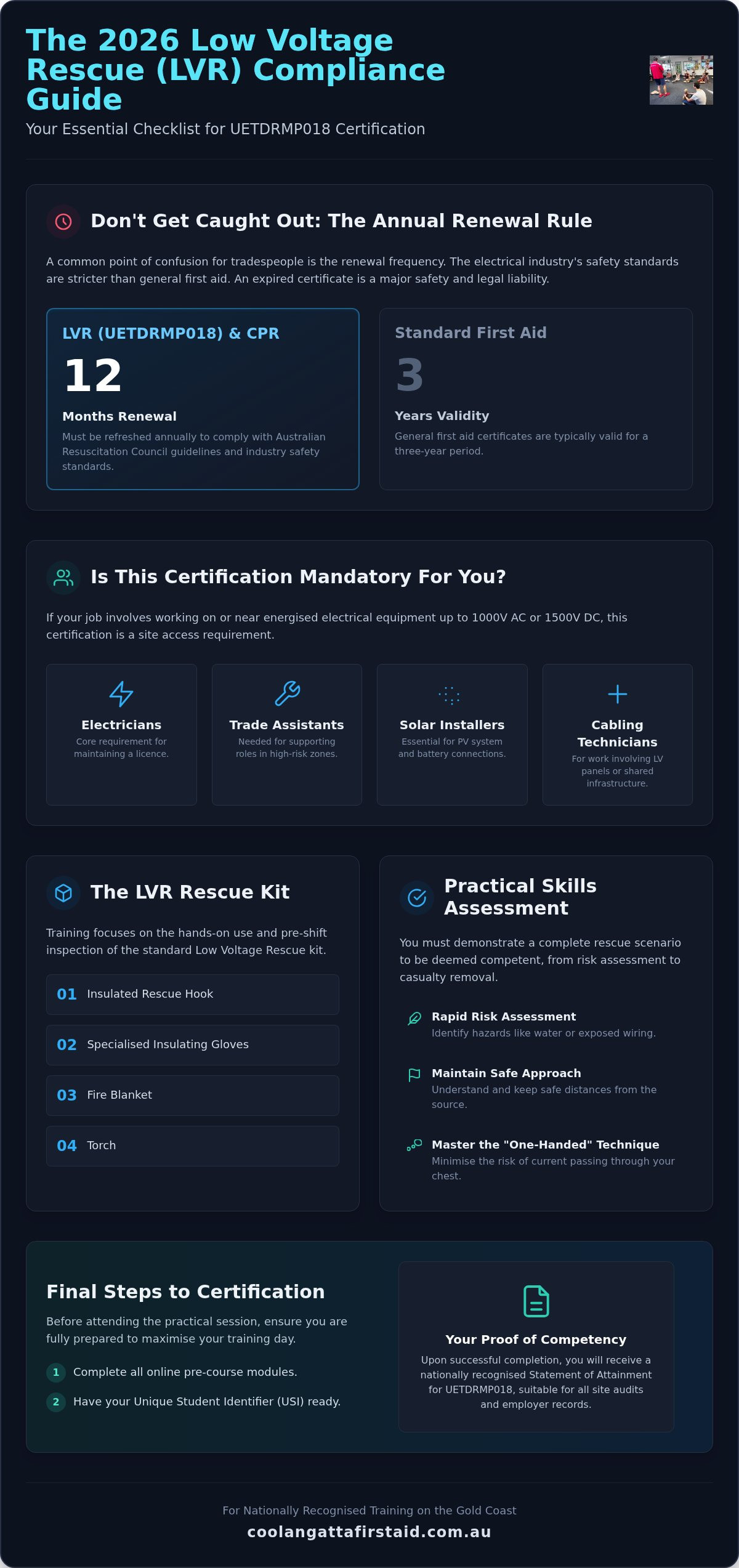
One of the biggest points of confusion for tradespeople is how often they need to get back into the classroom. While a standard first aid certificate is generally valid for three years, the electrical industry operates on a much tighter schedule. Under the Australian Resuscitation Council guidelines and state-based electrical safety rules, the CPR and LVR components must be refreshed every 12 months.
Working with an expired certificate isn’t just a safety risk; it’s a massive legal liability. If an incident occurs on-site and your training is out of date, insurance may be voided and your employer could face heavy fines. You should check your previous Statement of Attainment today. If the “Date of Issue” was more than a year ago, it’s time to organise your UETDRMP018 training Gold Coast to ensure your skills remain sharp and your compliance is current.
The LVR Course Content Checklist: What Your Training Must Cover
A high-quality course isn’t just about watching a slideshow; it’s about getting hands-on with the gear that could one day save your life. The nationally recognised UETDRMP018 unit outlines specific performance criteria that every student must meet to be deemed competent. When you undertake UETDRMP018 training Gold Coast, your instructor will focus heavily on the Low Voltage Rescue (LVR) kit. This typically includes an insulated rescue hook, a fire blanket, specialized insulating gloves, and a torch. Understanding how to inspect this gear for damage before a shift is just as critical as knowing how to use it during a crisis.
Practical Skills Assessment Checklist
The practical component of the course is where theory meets reality. You’ll be required to demonstrate a complete rescue scenario from start to finish. This begins with a rapid risk assessment of the scene to identify hazards like pooled water or exposed wiring that could endanger the rescuer. You’ll practice maintaining safe approach distances and using the insulated rescue hook to safely pull a casualty away from the live source.
One specific protocol you’ll master is the “one-handed” technique. By keeping one hand behind your back or in a pocket while performing certain rescue movements, you significantly reduce the risk of an electrical current passing through your chest if you accidentally make contact with a live component. These simulations are designed to be fast-paced, ensuring you can perform under pressure. If you need to refresh these skills for your team, you can organise a group session through Coolangatta First Aid to keep everyone’s techniques sharp.
First Aid and Resuscitation Requirements
Once the victim is clear of the live panel, the focus shifts immediately to medical care. Electrical shock often causes internal damage that isn’t immediately visible, so your training covers how to manage flash burns and potential cardiac arrest. This is where your HLTAID009 skills become vital. The assessment requires you to demonstrate high-quality CPR on a manikin on the floor, simulating the physical exhaustion of a real-world emergency.
You’ll also practice the deployment of an Automated External Defibrillator (AED). Because electrical incidents often happen in cramped or awkward workplace environments, your UETDRMP018 training Gold Coast prepares you to adapt these life-saving techniques to the specific challenges of a switchroom or industrial site. Mastering the transition from the physical rescue to the medical response is the hallmark of a competent safety observer.
Evaluating Training Providers: A Compliance Checklist
Selecting a provider for your UETDRMP018 training Gold Coast isn’t just about finding the closest classroom. It’s a decision that impacts your legal right to work on-site. You must verify that the organisation is a Registered Training Organisation (RTO) or an authorised third-party provider. Look for the “Nationally Recognised Training” logo on their website and course materials. This logo is a hallmark of quality and ensures the certificate you receive will be accepted by employers and site auditors across Australia.
Check the course code carefully before you book. As of 2026, you should be enrolling in the UETDRMP018 unit. While some providers might still mention older codes, the official UETDRMP018 unit details confirm this is the current standard for low voltage panel rescue. Choosing a provider that offers blended learning can save you hours of downtime. This format allows you to complete the theory online at your own pace before attending a shorter, practical assessment session. It’s a popular choice for busy tradespeople who can’t afford to lose a full day of billable hours to a classroom.
The Importance of RTO Accreditation
A non-accredited safety induction might teach you the basics, but it won’t satisfy a site auditor or the electrical safety office. Legal LVR requirements demand a Statement of Attainment from an RTO. You can verify any provider by searching the national register at training.gov.au. Family-run businesses like Coolangatta First Aid & CPR Training often act as authorised third-party providers for larger organisations like RTO 3399. This allows them to offer personalised, high-quality instruction while still issuing nationally recognised certificates that meet every legal hurdle.
Group vs Individual Training Options
For businesses with multiple staff needing a refresh, on-site training is often the most efficient path. Express group bookings allow your team to train together in their actual work environment using their own LVR kits. This mimics real-world scenarios better than a generic training centre setup. If you’re booking for a workplace, check if the provider has a minimum participant requirement. Most mobile trainers need a small group to make an on-site visit viable. This approach minimises disruption to your project timelines while ensuring every “sparky” on your payroll is compliant and ready for the job.
Your Training Day Preparation: A Step-by-Step Checklist
Arriving unprepared for your UETDRMP018 training Gold Coast can lead to unnecessary delays or even being unable to participate in the practical assessment. Because this unit involves high-risk simulations, training providers must follow strict enrolment and safety protocols. The first step in your preparation happens well before you step into the classroom. You must ensure you have a valid Unique Student Identifier (USI) ready. This 10-digit code is a mandatory Australian government requirement for all nationally recognised training. Without a verified USI, your provider cannot legally issue your Statement of Attainment, which could leave you stuck at the site gates on Monday morning.
On the day of your practical session, enrolment verification is the first order of business. You’ll need to bring a valid form of photo identification, such as a driver’s licence or passport. This ensures that the person performing the rescue is the person being certified. Since the course mimics a real-world electrical environment, your clothing choices matter. You must wear appropriate workplace attire, which includes long pants and closed-in shoes. Loose clothing or open footwear is a safety hazard during a rescue simulation and will likely result in you being asked to change before participating.
The Pre-Course Theory Component
The blended learning format is a game-changer for busy tradespeople. By completing the online theory modules before attending the face-to-face session, you significantly reduce the time spent in a classroom. These modules cover the essential knowledge you need to stay safe, including the latest ESI safety rules, risk assessment frameworks, and the legalities of the Work Health and Safety Act.
Navigating the student portal is usually straightforward, but don’t leave it until the night before. You’ll need to work through several sections and submit assessments to prove you understand the theory of low voltage rescue. This preparation allows the instructor to focus entirely on hands-on skills during the practical session, ensuring you get the most out of the experience. You can book your LVR and CPR refresher online to get immediate access to these theory modules and start your preparation today.
What to Bring to Your Practical Session
While the training provider supplies the specialised LVR kits and manikins, you should bring any personal note-taking materials you prefer. If you’re renewing a previous certification, having a copy of your old Statement of Attainment can be helpful for the trainer to verify your previous experience.
The most important thing to bring is a proactive attitude. The practical session is high-energy and requires you to be physically active as you perform CPR and move casualties using the rescue hook. Be prepared to work closely with other students as you simulate a safety observer role. This collaborative environment is designed to build your confidence so that if a real emergency ever occurs, your instincts will take over and you’ll know exactly what to do.
Next Steps: Securing Your Nationally Recognised LVR Certificate
Once you finish the practical assessment for your UETDRMP018 training Gold Coast, the final step is receiving your formal credentials. In 2026, the standard practice is to receive your Statement of Attainment via email as a digital PDF. This digital-first approach is highly efficient for tradies who need to provide proof of competency to multiple employers or site supervisors. Unlike a paper certificate that can get lost or damaged in a ute, a digital file is always accessible on your smartphone for instant verification during a site audit.
Integrating your LVR qualification with other essential units is a smart way to manage your professional development. Many electrical contractors choose to align their rescue training with HLTAID011 Provide First Aid to ensure a comprehensive safety profile. While the LVR and CPR components require an annual refresh, the broader first aid unit generally lasts for three years. Keeping a digital log of these differing expiry dates prevents you from being caught out by an expired ticket at the start of a major project.
Managing Your Safety Credentials
Site access often depends on how quickly you can produce your paperwork. We recommend saving your digital certificate in a dedicated folder on your phone or using a cloud-based storage app. You should also update your details on any relevant trade licence portals or employer compliance systems as soon as your certificate arrives. If your work extends into specialised environments, you might also need to link your credentials with a childcare first aid refresher Gold Coast or other industry-specific units. Setting a calendar reminder for your 2027 annual refresher right now is the best way to ensure your compliance never lapses.
Booking Your Next Course
The most efficient way to stay on top of your training is to use an online booking system that offers 24/7 convenience. Local family-run businesses like Coolangatta First Aid & CPR Training specialise in providing a personalised experience that larger, corporate providers often lack. They understand the pressure of trade schedules and offer express formats that respect your time. Whether you’re an individual sparky or managing a large team, choosing a provider that is a third-party for RTO 3399 guarantees your training is nationally recognised and audit-ready. Organise your UETDRMP018 training with the experts today and keep your career moving forward safely.
Stay Compliant and Safe on Every Site
Maintaining your LVR and CPR certification isn’t just about meeting a legal requirement. It’s about ensuring you have the sharp instincts needed to act when a mate’s life is on the line. By following the 2026 checklist, you’ve seen that modern training prioritises efficiency through blended learning and practical simulations. You now understand the importance of the 12-month renewal cycle and how to verify your provider’s RTO credentials before you step into the classroom.
Securing your UETDRMP018 training Gold Coast with a trusted provider ensures your Statement of Attainment is nationally recognised and audit-ready. As a family-run Australian business and a third-party provider for RTO 3399, we specialise in express practical sessions that get you back on the tools faster. Book your UETDRMP018 Low Voltage Rescue training now to secure your spot. Don’t leave your compliance to the last minute. Take control of your safety credentials today and work with the confidence that comes from being fully prepared for any emergency.
Frequently Asked Questions
Is UETDRMP018 the same as the old LVR course?
Yes, UETDRMP018 is the current nationally recognised unit that replaces the older UETDRMP007 and UETTDRRF004 versions. It covers the same essential skills for performing a rescue from a live low voltage panel but is updated to meet the latest Australian training standards. When you enrol in UETDRMP018 training Gold Coast, you’re getting the most up-to-date certification required by modern electrical safety regulations across the country.
How long does the UETDRMP018 certificate stay valid in Australia?
While a Statement of Attainment technically doesn’t have an expiry date, the electrical industry operates on a strict 12-month renewal cycle. Both the Australian Resuscitation Council and state-based electrical safety regulators mandate that the LVR and CPR components be refreshed every year. Keeping your skills current through annual training is vital for maintaining site access and ensuring you can respond effectively in a high-voltage emergency.
Can I do my LVR training entirely online?
No, you cannot complete this certification entirely online because it requires a physical demonstration of skills. While you can finish the theory modules through a student portal, the national training package requires a face-to-face practical assessment. You must demonstrate that you can safely use a rescue hook and perform CPR on a manikin to be deemed competent by your instructor and receive your certificate.
Do I need to have a current CPR certificate before starting UETDRMP018?
Yes, HLTAID009 Provide cardiopulmonary resuscitation is a mandatory co-requisite for the low voltage rescue unit. Most training providers deliver these two units together as a single package to ensure you meet all legal requirements. If you already hold a current CPR certificate from another RTO, you should check with your provider to see if they can credit it toward your UETDRMP018 training Gold Coast enrolment.
How long is the practical session for a Low Voltage Rescue course?
In a blended learning format, the face-to-face practical session typically takes between 60 and 90 minutes. This follows the completion of approximately three to four hours of online theory work. This express approach is designed specifically for busy tradespeople who need to maintain their compliance without losing a full day of billable hours on the tools. Group bookings on-site can sometimes take longer depending on the number of participants.
What happens if my LVR certificate expires before I do a refresher?
If your certificate expires, you are no longer legally compliant to act as a safety observer or work on live electrical panels on most commercial sites. There is no official grace period for safety-critical certifications in the electrical industry. You’ll need to book and complete the UETDRMP018 unit immediately to restore your compliance. Working with an expired ticket can void insurance and lead to significant fines for your employer.
Is the UETDRMP018 unit recognised in all Australian states?
Yes, UETDRMP018 is a nationally recognised unit of competency that is accepted in every Australian state and territory. Because it is part of the official ESI Training Package, a Statement of Attainment issued by a Registered Training Organisation (RTO) or an authorised third-party provider is valid across the country. This portability is essential for contractors and “sparkies” who move between different interstate projects and jurisdictions.
What specific PPE do I need for the practical LVR assessment?
You must wear standard workplace clothing, including long trousers and closed-in footwear, to participate in the practical assessment. While the training provider usually supplies the specialised equipment like insulated gloves and rescue hooks, wearing your everyday work gear ensures the simulation is as realistic as possible. Avoid wearing loose jewellery or synthetic clothing that wouldn’t be appropriate in a real-world electrical environment. This helps you practice safe habits during the rescue.
