
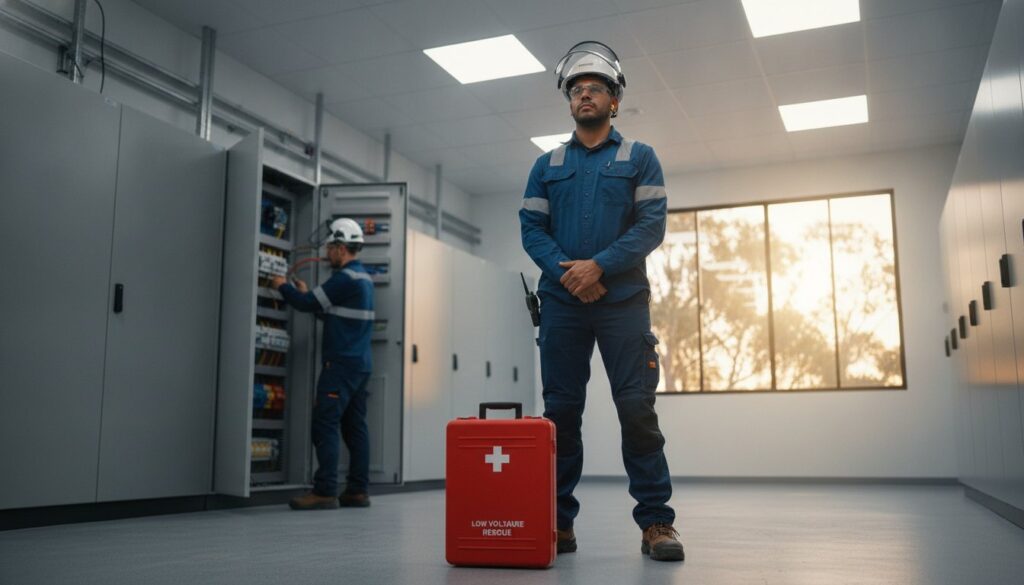
If you’re standing in front of a live panel as the designated Safety Observer, would your muscle memory take over in an emergency, or would you freeze? It’s a heavy responsibility that every sparkie carries, and keeping up with the constant paperwork and unit code changes like the shift to UETDRMP018 can feel like a full-time job. Enrolling in a low voltage rescue course is about more than just ticking a compliance box; it’s about having the confidence to act when seconds count.
We know the frustration of tracking annual expiry dates and the anxiety of wondering if your skills are still sharp enough for a real-world rescue. You’ve likely heard the talk about UETDRMP007 being phased out, and you need to know how the current standards affect your licence renewal. This guide, brought to you by Coolangatta First Aid & CPR Training, breaks down the vital safety requirements and rescue techniques you’ll need to stay safe on site in 2026. From mastering the LVR kit to understanding the latest national safety regulations, we’ve got the clear answers you need to stay on the tools without the stress of a lapsed certification.
Key Takeaways
- Understand why the Queensland Electrical Safety Regulation 2013 mandates annual LVR and CPR training for all licensed electrical workers to maintain their licence.
- Learn why the current UETDRMP018 unit is the national standard for any low voltage rescue course Queensland and how it integrates with HLTAID009 Provide CPR.
- Identify the essential components of an Australian Standard LVR kit and the specific inspection routines required to ensure your gear is site-ready.
- Master the critical responsibilities of a Safety Observer, moving beyond being a bystander to applying the DRSABCD protocol in electrical emergencies.
- Prepare for your next renewal by gathering your USI and PPE to ensure a smooth, fast-tracked certification process with an experienced training provider.
Why Annual LVR Training is Non-Negotiable for Queensland Electricians
Low Voltage Rescue (LVR) isn’t just a suggestion; it’s a critical safety net for every sparkie on site. When an electrical accident occurs, the victim’s life depends on a colleague knowing exactly how to safely isolate the power and extract them from a live panel without becoming a second casualty. Understanding Electrical Injuries is the first step in realising why these protocols exist. The physical damage from even brief contact with low voltage can be catastrophic, leading to internal burns or cardiac arrest.
In Queensland, the Electrical Safety Regulation 2013 sets the bar high. It dictates that anyone performing or assisting with live electrical work must be competent and refreshed in specific rescue techniques. This isn’t just about technical skill; it’s a legal “Duty of Care.” Employers must provide a safe workplace, and employees must follow safety procedures to protect themselves and their mates. Completing a low voltage rescue course Queensland ensures you’re meeting these obligations while staying current with the latest industry standards.
The Legal Framework in Queensland
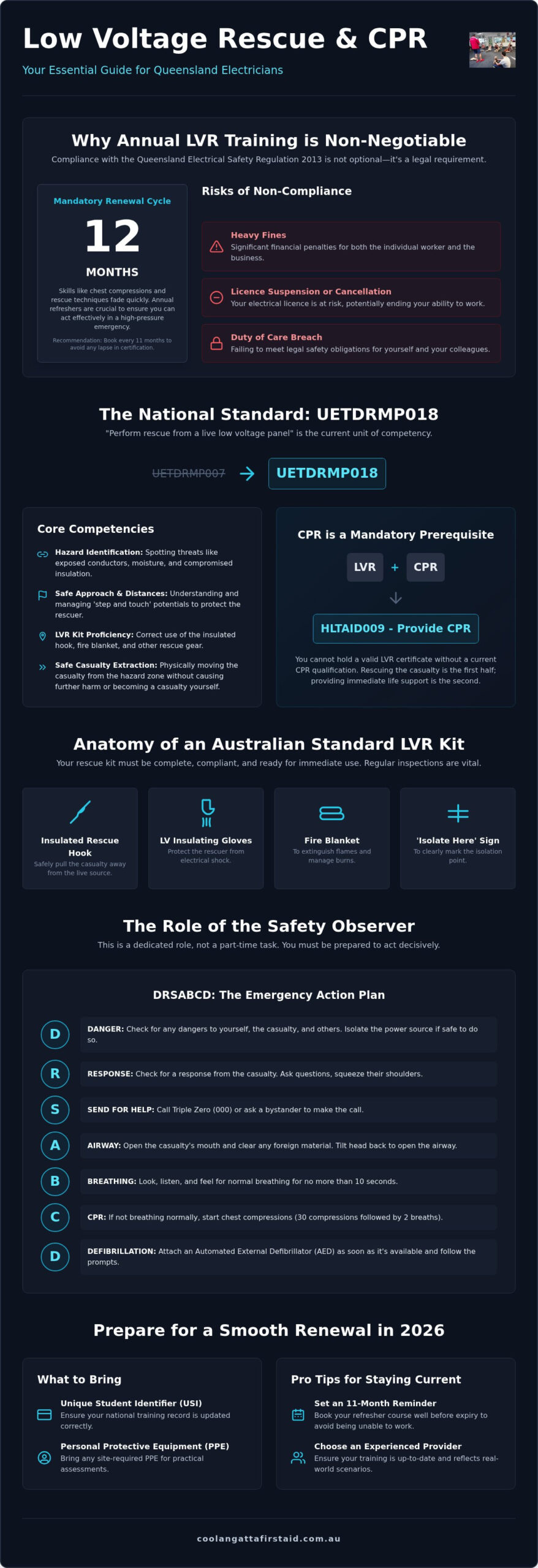
The Electrical Safety Office (ESO) acts as the industry watchdog, ensuring that safety standards are strictly maintained across the state. One of their most critical requirements is the presence of a “Safety Observer” during live work. This person’s sole job is to monitor the worker and be ready to perform a rescue if things go wrong. They can’t be distracted by other tasks or tools. If you’re caught on site acting as an observer without a current UETDRMP018 and HLTAID009 certificate, the penalties are steep. Beyond heavy fines for both the individual and the business, you risk your electrical licence being suspended or cancelled, which effectively puts you out of work.
The 12-Month Renewal Cycle
You might wonder why LVR requires a yearly refresher when standard first aid qualifications often last three years. The reason is simple: skill fade. The Australian Resuscitation Council (ARC) notes that physical skills like chest compressions and the specific steps of an LVR hook rescue degrade quickly. Within twelve months, your ability to perform a high-pressure rescue drops significantly. By 2026, the transition to the UETDRMP018 unit is the absolute standard for your annual refresher. It’s smart to set a calendar reminder to book your training every 11 months. This gives you a small buffer to ensure you never have a gap in your certification or your ability to work on live sites.
Understanding UETDRMP018: The National Standard for Low Voltage Rescue
While the legal mandate sets the schedule, the UETDRMP018 national standard defines the actual skills you need to save a life. This unit, titled “Perform rescue from a live low voltage panel,” replaced older versions to better reflect modern site hazards. It isn’t a course you can simply pass by reading a manual. Because the stakes are so high, the assessment involves a rigorous blend of theoretical knowledge and hands-on practical demonstrations. You’ll need to prove you can think clearly while physically executing a rescue using an insulated hook and other specialized gear. If you’re looking to refresh these skills, booking a low voltage rescue course Queensland with an experienced provider ensures you’re learning the most current techniques used in the field.
Core Competencies of the Unit
The heart of the training lies in hazard identification. You’ll learn to spot immediate threats like exposed conductors, moisture, or compromised insulation before you even step into the rescue zone. A major focus is placed on safe approach distances and the management of “step and touch” potentials. These concepts are vital; they explain how electricity can travel through the ground or between objects, potentially striking a rescuer who isn’t careful. Practical components of the course require you to demonstrate the correct use of an LVR kit, including the application of a fire blanket and the physical extraction of a mannequin from a simulated live LV apparatus. You must show that you can maintain your own safety while moving the casualty to a secure area for further treatment.
The CPR Prerequisite (HLTAID009)
You cannot hold a valid LVR certificate without a current CPR qualification. In almost every electrical incident, the rescue is only the first half of the battle. Once the casualty is clear of the live source, they often require immediate resuscitation due to the impact of the current on their heart rhythm. This is why HLTAID009 Provide cardiopulmonary resuscitation is taught alongside LVR. You’ll learn how to manage a casualty suffering from severe electric shock or arc flash burns, focusing on keeping the airway clear and maintaining blood flow until paramedics arrive. The UETDRMP018 unit represents the current industry benchmark for 2026, ensuring all electrical workers possess the specific skills required to manage a live LV panel rescue safely. This integrated approach ensures that if a mate goes down, you have the full toolkit of skills to give them the best possible chance of survival.
The Anatomy of a Low Voltage Rescue Kit
Having the right gear on site is just as important as knowing how to use it. An Australian Standard LVR kit isn’t a standard first aid box; it’s a specialised collection of tools designed to withstand high-voltage environments while protecting the rescuer. During a low voltage rescue course Queensland, you’ll spend significant time familiarising yourself with these components because, in a real emergency, you won’t have time to read the labels. Every item in the bag has a specific purpose, from isolating the victim to treating the immediate aftermath of an arc flash.
A compliant kit must be easily accessible and clearly marked. Most kits include:
- Insulated Rescue Hook: A non-conductive shepherd’s crook used to pull a victim away from a live source.
- Insulated Gloves: Typically Class 0 gloves rated to 1000V, providing the primary barrier between you and the current.
- Fire Blanket: Used to smother flames if the victim’s clothing catches fire during an arc flash.
- Burns Dressings: Hydrogel-based dressings specifically for treating electrical or thermal burns.
- “Isolate Here” Signage: To clearly mark the point of isolation for emergency services.
- LED Torch: Essential for visibility if the incident has caused a power outage.
Essential Components Breakdown
The rescue hook is the most iconic part of the kit. It’s usually made from high-grade fibreglass or similar non-conductive materials to ensure the rescuer remains isolated from the panel. It’s designed to be strong enough to pull a fully grown adult but light enough to be handled with precision. Along with the hook, your insulated gloves are your last line of defence. These must be tested and tagged every six months to ensure their dielectric integrity. Using a pair of gloves with even a microscopic tear can lead to a fatal shock, which is why understanding the rating and testing cycle is a core part of any low voltage rescue course Queensland sparkies attend.
Maintenance and Compliance
Owning a kit isn’t enough; you must maintain it. Before every shift where live work is performed, the Safety Observer should perform a quick “air test” on the insulated gloves. By rolling the glove from the cuff to trap air inside, you can check for pinholes or cracks. If the glove deflates, it’s garbage. Proper storage is also vital. UV radiation and chemical fumes can degrade the rubber in gloves and the resin in the rescue hook. Keep your kit in a cool, dry place, and never throw heavy tools on top of it. Finally, check the batteries in your torch and the expiry dates on your burns dressings. A dead torch or a dried-out dressing makes an LVR kit useless when the pressure is on.
The Role of the Safety Observer and Rescue Procedures
The Safety Observer is the most important person on a live site, yet the role is frequently misunderstood as a passive bystander. In reality, the observer is a tactical supervisor with the legal authority to halt work the moment a safety boundary is breached. They’re the primary lifeline for the worker at the panel. Effective communication is the foundation of this partnership. Before work begins, the worker and observer must agree on verbal cues or hand signals, ensuring there’s no ambiguity if an emergency occurs. This level of coordination is a focal point of any quality low voltage rescue course Queensland providers deliver, as it prevents the hesitation that costs lives.
Safety Observer Responsibilities
A Safety Observer must maintain an unobstructed line of sight to the person performing the work at all times. This means no scrolling on phones, no wandering off for tools, and no engaging in side conversations. Their focus is absolute. If the worker moves into a restricted zone or if environmental conditions change, the observer must call a “stop work” immediately. When an incident happens, the observer also manages the emergency communication. They must be able to call 000 and provide precise location data while simultaneously preparing to initiate the rescue sequence. This multi-tasking under pressure is why annual training is so vital; it turns a frantic reaction into a disciplined response.
Executing the Rescue Safely
When a worker is incapacitated by a shock, the observer must follow a modified DRSABCD protocol. In an electrical context, “Danger” is the most complex step. You cannot touch the casualty until the power is gone. The standard rescue sequence follows these specific steps:
- Isolate: Switch off the main breaker or pull the fuse. If the isolation point is unknown or inaccessible, you must move to the next step with extreme caution.
- Rescue: Using the insulated gloves and hook from the kit, pull the casualty clear of the live source by their waist or under the armpits.
- Assess: Once the casualty is in a safe zone, check for breathing and a pulse.
- Resuscitate: Begin CPR (HLTAID009) immediately if they’re unconscious and not breathing.
Managing the aftermath is just as critical. Even if the victim regains consciousness, they may suffer from internal tissue damage or delayed cardiac issues. Ensure they remain still and covered with a fire blanket to manage shock while waiting for paramedics. If you need to refresh these life-saving skills, you can book your annual LVR and CPR update to ensure you’re ready for any site emergency.
How to Organise Your LVR and CPR Certification in 2026
Finding the right training partner is the final step in securing your career for the next twelve months. When you’re looking for a low voltage rescue course Queensland, you want an instructor who speaks your language and understands the specific pressure of a live switchboard environment. It’s not just about getting a piece of paper; it’s about ensuring your team is genuinely prepared for a worst-case scenario. Choosing a provider that specialises in the electrical industry means the training will focus on the real-world hazards you face every day, rather than generic first aid theory.
Preparation Checklist for Students
Before you step into the training room, you’ll need to have your Unique Student Identifier (USI) ready. This is a federal requirement for all nationally recognised training in Australia. If you don’t have one or can’t find yours, it’s best to sort it out via the government portal before your session. Physical readiness is also a factor. The assessment requires you to perform at least two minutes of continuous, floor-based CPR on a manikin. If you have an injury or condition that might prevent this, talk to your provider beforehand. To ensure a smooth session, you should bring the following items:
- Your active Unique Student Identifier (USI)
- Relevant Personal Protective Equipment (PPE) like insulated gloves
- Comfortable clothing suitable for floor-based practical tasks
- A copy of your current USI transcript if requested
For a detailed list of what to pack in your kit, check our comprehensive UETDRMP018 training checklist for a full prep list.
Booking Your 2026 Refresher
Coolangatta First Aid & CPR Training specialises in fast-tracked, accredited training as a third-party provider for ABC LicenceTraining (RTO 3399). We offer flexible delivery options, including face-to-face sessions that get you back on site quickly without compromising on quality. For electrical businesses with multiple staff, group training can be a more efficient way to get everyone compliant at once. Once you’ve successfully completed the assessment, you’ll receive a digital Statement of Attainment for UETDRMP018 and HLTAID009. This digital record is your proof of competency for the Electrical Safety Office and site inductions, and it’s much easier to track than a physical card that can get lost in a toolbox. Don’t let your credentials expire and risk your ability to work on live sites. Book your Low Voltage Rescue and CPR course today to keep your licence current and your skills sharp.
Stay Current and Safe on Site in 2026
Mastering the current UETDRMP018 unit and the specific responsibilities of a Safety Observer ensures you’re ready for more than just a compliance audit. It’s about protecting your mates and your livelihood by maintaining an in-date LVR kit and sharp rescue skills. Completing a low voltage rescue course Queensland is the most effective way to bridge the gap between regulatory theory and life-saving practice on a live site.
Don’t let your annual renewal slide and risk your electrical licence. We provide nationally recognised training with expert instructors who possess deep knowledge of the electrical industry. You’ll benefit from fast-tracked certification that respects your busy schedule while giving you the practical confidence to act if an emergency occurs. Secure your 2026 LVR and CPR certification with Coolangatta First Aid & CPR Training today. Your expertise is the ultimate safety net for every sparkie you work with.
Frequently Asked Questions
Is LVR training mandatory for all electricians in Queensland?
Yes, it’s mandatory for any electrical worker performing or assisting with live electrical work. The Queensland Electrical Safety Regulation 2013 requires workers to be competent in rescue and resuscitation. This includes safety observers who must be trained to perform a rescue. Holding a current certification ensures you meet your legal duty of care on every site and remain compliant with state safety standards.
How often do I need to renew my Low Voltage Rescue certification?
You must renew your LVR and CPR certification every 12 months. While some first aid certificates last three years, the electrical industry requires a yearly refresher due to the high-risk nature of the work. This annual cycle ensures that your physical skills, like using a rescue hook or performing chest compressions, remain sharp and effective during an actual emergency when seconds count.
Can I do a Low Voltage Rescue course online?
No, you cannot complete a low voltage rescue course Queensland entirely online. While some providers offer a blended approach with online theory, you must attend a face-to-face session for the practical assessment. You need to physically demonstrate that you can use an LVR kit and perform CPR on a manikin. These hands-on skills are essential for proving competency in a real-world rescue scenario.
What is the current unit code for Low Voltage Rescue training in 2026?
The current nationally recognised unit code is UETDRMP018 Perform rescue from a live low voltage panel. This unit replaced the older UETDRMP007 version, which was phased out by August 2026. When booking your training, ensure the provider is delivering this latest standard. It covers the modern safety requirements and technical skills needed for rescue operations in the Australian electrical industry today.
Do I need to have a current CPR certificate to do an LVR course?
CPR training is a mandatory component of the LVR certification process. Most training providers deliver HLTAID009 Provide cardiopulmonary resuscitation alongside the UETDRMP018 unit. You cannot be deemed competent in low voltage rescue without also proving you can perform resuscitation. This is because a rescue is often followed immediately by the need for life-saving CPR after an electric shock or cardiac event.
What happens if my LVR certificate expires?
If your certificate expires, you are no longer legally allowed to perform live electrical work or act as a Safety Observer. Working with an expired qualification can lead to significant penalties from the Electrical Safety Office. It also puts your electrical licence at risk. Most importantly, it means your skills might not be sharp enough to save a mate’s life if an accident occurs on site.
What is included in a standard Low Voltage Rescue kit?
A standard Australian LVR kit contains several specialised items designed for electrical safety. These typically include an insulated rescue hook, Class 0 insulated gloves rated to 1000V, a fire blanket, and burns dressings. You’ll also find an LED torch for low-light situations and “Isolate Here” signage. Every component must be regularly inspected to ensure it hasn’t degraded from UV exposure, chemicals, or physical wear.
How long does a typical LVR and CPR course take to complete?
A combined face-to-face training session usually takes between three and four hours to complete. This timeframe allows for both the theoretical review of safety protocols and the mandatory practical assessments. Some providers offer a fast-tracked option for experienced tradespeople who have maintained their annual renewals. This ensures you spend less time in the classroom and more time on the tools while staying fully compliant.
