
What if the first aid certificate you just paid for is completely useless when you’re standing on a job site? It’s a valid concern, particularly when you’re trying to find an accredited first aid course Australian workers can rely on to meet the latest 2026 national standards. Between shifting regulations and the alphabetical soup of unit codes like HLTAID009 versus HLTAID011, it’s easy to feel overwhelmed. You’re likely looking for more than just a piece of paper; you want the genuine confidence to handle a medical emergency without the fear of wasting money on training that isn’t recognised by your employer.
Here at Coolangatta First Aid & CPR Training, we’ve designed this guide to clear the confusion and help you master the essentials of nationally recognised training. You’ll learn exactly which unit codes apply to your specific industry, how to verify a provider’s RTO status, and how to secure your certification without disrupting your entire work week. We’ll also preview the current Australian Resuscitation Council guidelines and the benefits of modern blended learning. By the end, you’ll know exactly how to get your same-day certificate and stay compliant with Australian workplace laws while being supported by training that prioritises your success.
Key Takeaways
- Understand the role of Registered Training Organisations (RTOs) and why nationally recognised certification is the only way to meet Australian workplace safety standards in 2026.
- Decode common unit codes like HLTAID009 and HLTAID011 so you can select the correct training level for your specific job role or industry.
- Learn about specialist requirements for high-risk sectors, including Low Voltage Rescue for electricians and HLTAID012 for those in education and care settings.
- Discover why booking an accredited first aid course Gold Coast through a family-run provider offers better student support and higher skill retention than large corporate centres.
- Prepare for your practical assessment by understanding the balance between online theory and face-to-face manikin demonstrations for both adult and infant CPR.
What Defines an Accredited First Aid Course in Australia?
When you sign up for an accredited first aid course Gold Coast students expect, you aren’t just paying for a seat in a classroom. You’re entering the Vocational Education and Training (VET) sector, a robust system designed to ensure every trainee walks away with life-saving skills that meet Australian workplace standards. An accredited course is one that meets the HLT Health Training Package requirements. This ensures that whether you are performing CPR or managing a fracture, your techniques align with current medical best practices and the latest 2026 regulations.
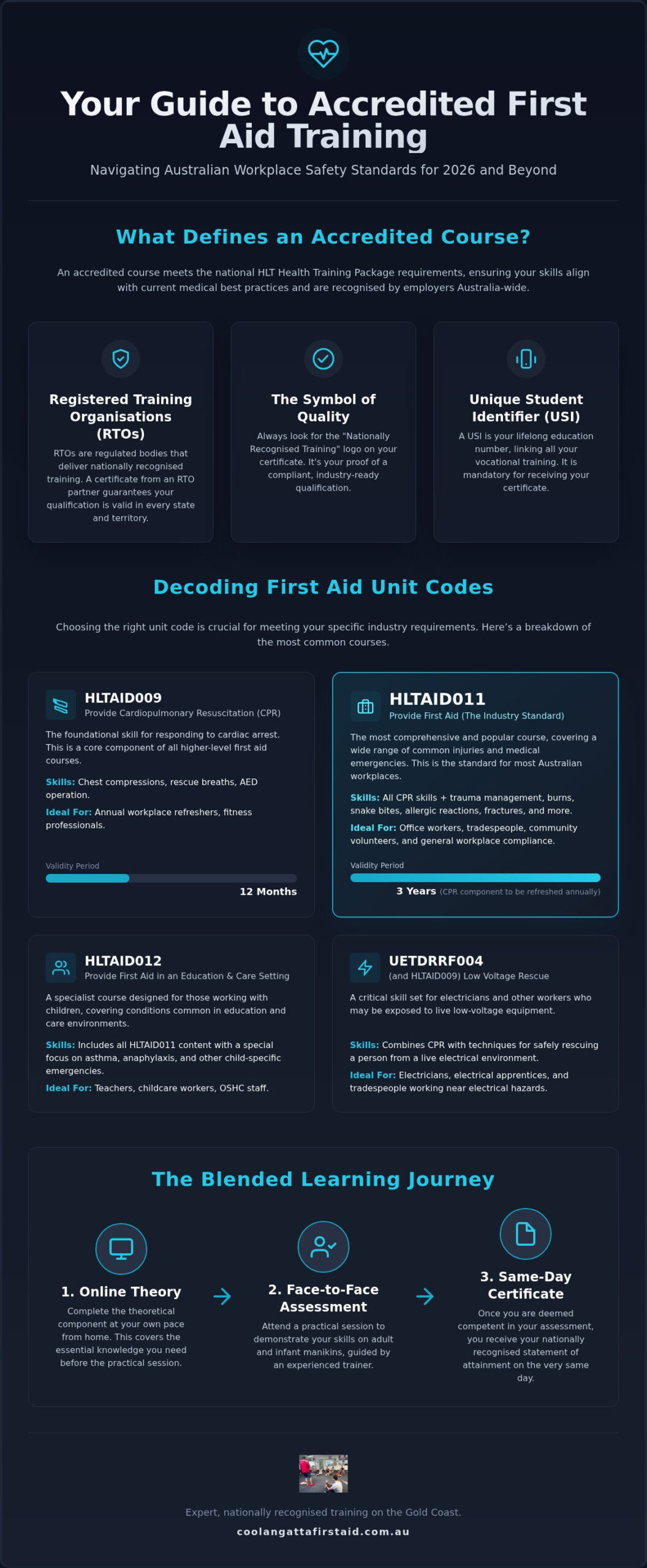
The backbone of this system is the Registered Training Organisation (RTO). These bodies are heavily regulated to maintain strict educational standards. When you receive your certificate, look for the “Nationally Recognised Training” logo. This symbol is your guarantee that the qualification is valid in every state and territory. The standardisation of these courses provides a reliable framework for safety, much like the protocols observed by Emergency medical services in Australia. Without this accreditation, your training may not be accepted by employers or insurance providers.
The Importance of RTO Partnerships
Not every training centre is a standalone RTO; many high-quality, family-run businesses operate as third-party providers. This family-run business delivers nationally recognised units through a partnership with ABC LicenceTraining (RTO 3399). This model offers the best of both worlds. You get the personalised support and smaller class sizes of a family business, while your certification is backed by a major national RTO. It ensures your trainer is qualified under the latest national standards and that your HLTAID011 Provide First Aid certificate is fully compliant and industry-ready.
Understanding Your USI (Unique Student Identifier)
If you’ve undertaken any vocational training in Australia since 2015, you likely already have a USI. This ten-digit number is your lifelong education reference. It creates a secure online record of all your recognised training and results. You cannot receive a statement of attainment for an accredited first aid course Gold Coast providers offer without a valid USI.
- Why it matters: It links your training records to your national transcript for easy employer verification.
- How to get one: Visit the official USI website to create your identifier using a form of ID like a driver’s licence or Medicare card.
- Preparation: Have your USI ready before your course starts to ensure your certificate can be issued on the same day.
Comparing HLTAID011, HLTAID009, and Specialist Certification
Choosing the right accredited first aid course Gold Coast professionals need starts with understanding the specific unit codes required for your role. HLTAID009 Provide cardiopulmonary resuscitation is the absolute foundation. It covers the essential skills for keeping a person alive until paramedics arrive. While this unit is a component of larger courses, many industries require it to be refreshed every 12 months to maintain peak competency.
The HLTAID011 Provide First Aid unit is the comprehensive industry standard. It builds on CPR by adding trauma management, snake bite treatment, and allergic reaction response. This nationally recognised HLTAID011 qualification is generally valid for three years. It’s the most popular choice for office workers, tradespeople, and general community members across Australia.
| Unit Code | Course Title | Validity | Primary Skills Covered |
|---|---|---|---|
| HLTAID009 | Provide CPR | 12 Months | Chest compressions, breaths, AED use |
| HLTAID011 | Provide First Aid | 3 Years | CPR, trauma, burns, bites, stings |
| HLTAID014 | Advanced First Aid | 3 Years | Triage, advanced scene management |
| HLTAID015 | Advanced Resuscitation | 12 Months | Oxygen therapy, suction, OP airways |
Advanced First Aid and Resuscitation
For those working in remote areas or high-risk industrial sites, HLTAID014 Provide Advanced First Aid is often mandatory. It moves beyond basic care into complex triage and advanced scene management. If your role involves clinical equipment, HLTAID015 Provide advanced resuscitation & oxygen therapy is the next step. This unit teaches the use of oxygen cylinders, suction units, and oropharyngeal airways. Supervisors might also need HLTAID016 Manage first aid services and resources to oversee workplace compliance and equipment maintenance effectively.
Specialised Units: Asthma and Anaphylaxis
Certain environments require deeper knowledge than a general course provides. Units 22702VIC (Asthma) and 22578VIC (Anaphylaxis) are standalone qualifications that focus on life-threatening respiratory and allergic events. These are vital for school staff and fitness instructors who work in high-allergy environments. You can easily view upcoming training dates to see how these specialist units can be integrated into your schedule. Regular refreshers in these areas are critical as protocols for medication administration can change.
Industry Requirements: From Sparkies to Childcare Workers
Compliance isn’t a one-size-fits-all concept in the Australian workforce. Your specific job role dictates which unit of competency you need to hold to stay on the right side of the law. For those in the electrical industry, the requirements are particularly stringent. Under the Electrical Safety Act 2002, licensed electricians and assistants must be proficient in UETDRMP018 Perform rescue from a live low voltage panel. This unit prepares you to safely remove a victim from a live electrical situation without becoming a casualty yourself. LVR training must be renewed every 12 months for Australian sparkies to ensure these high-stakes skills remain sharp and instinctive.
When searching for an accredited first aid course Gold Coast employers will actually accept, it’s vital to check the national training register for the exact unit codes required by your industry body. While general office staff might only need the standard HLTAID011, other sectors have unique benchmarks for safety and emergency response. This family-run business ensures every student receives support tailored to their specific career path, whether they’re working on a construction site or in a classroom. Businesses managing multiple staff certifications at once may also benefit from on-site first aid training Gold Coast services that bring nationally recognised group sessions directly to your workplace.
First Aid in Education and Care Settings
If you work in a childcare centre, preschool, or school, you’re likely required to hold the HLTAID012 Provide First Aid in an Education and Care Setting qualification. This unit is specifically approved by the Australian Children’s Education and Care Quality Authority (ACECQA) as meeting all first aid, asthma, and anaphylaxis requirements. Unlike the standard HLTAID011, this course places a heavy emphasis on paediatric CPR, infant manikin practice, and managing medical emergencies common in younger children. It’s the mandatory standard for educators who have a duty of care for Australia’s youngest citizens.
Manual Tasks and Workplace Safety
Physical safety extends beyond emergency response to include the way we move every day. The unit HLTWHS005 Conduct manual tasks safely is a critical addition for anyone in healthcare, aged care, or logistics. Musculoskeletal injuries are among the most common workplace claims in Australia, and this training focuses on identifying risks before they lead to long-term physical damage. Integrating manual handling training with your first aid certification doesn’t just protect your health; it creates a strong business case for employers by reducing downtime and workers’ compensation premiums. It’s a practical investment in a sustainable, injury-free career.
The Practical Assessment: What to Expect During Training
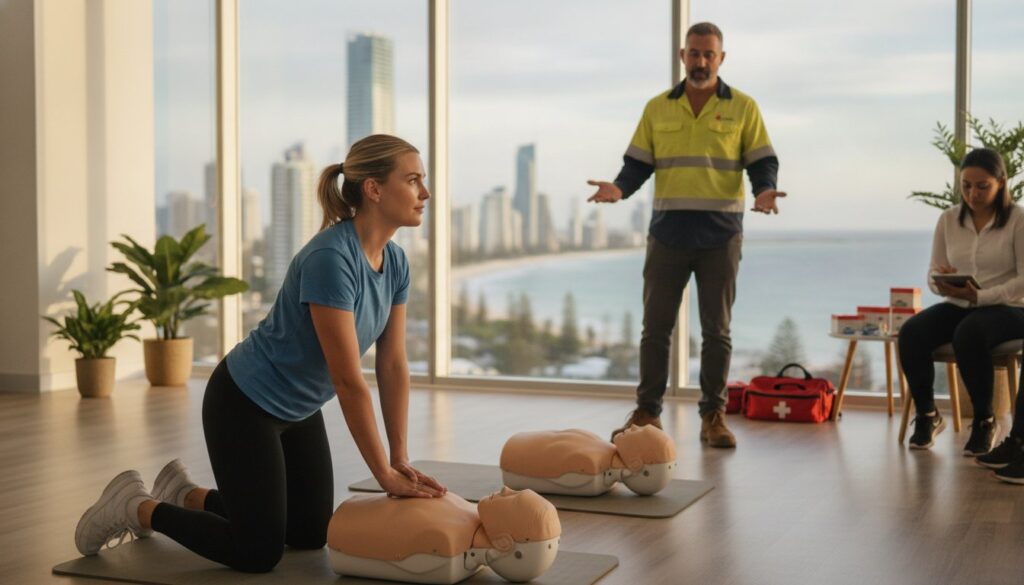
Most modern training providers have moved toward a blended learning model. You complete the theory components online at your own pace before attending a face-to-face workshop. When you arrive for your accredited first aid course Gold Coast session, the focus shifts entirely to physical competence. You won’t be sitting through hours of PowerPoint slides. Instead, you’ll be on the floor, proving you can apply what you’ve learned in a simulated emergency environment.
The Australian Resuscitation Council (ARC) guidelines dictate the specific standards you must meet to be deemed competent. For example, you must demonstrate continuous CPR on an adult manikin for two minutes while kneeling on the floor. You’ll also need to show proficiency with infant manikins, as the technique for a baby differs significantly from an adult. Trainers also guide you through scenario-based assessments. You might be asked to manage a simulated arterial bleed, immobilise a suspected fracture, or treat a bite from a venomous snake using the correct pressure immobilisation technique.
Preparing for Your Practical Session
Comfort is your priority. Since you’ll be kneeling and moving frequently, wear flexible clothing and closed-toe shoes. Activewear or work trousers are usually the best choice. Don’t forget to bring your photo ID and ensure your USI is verified in the system. Accessing your pre-course reading materials through the student portal a few days early is highly recommended. This preparation ensures you walk into the classroom with the confidence to handle the equipment and the drills without feeling rushed.
Same-Day Certificate Issuance
In 2026, the transition to digital certification is complete across the VET sector. The process for validating your competency is now streamlined and efficient. Once your trainer signs off on your practical skills, the data is synced with the RTO. Most students receive their digital certificate via email before they even get home from the class. These PDF documents are nationally recognised and easy to upload to employer portals. If you ever lose your file or need a replacement, you can simply log back into the student portal to download a fresh copy.
Take the first step toward your new qualification. You can view our upcoming course calendar and choose a session that fits your busy work schedule.
Selecting a Family-Run Provider for Your Accredited Training
Large corporate training centres often operate like assembly lines, moving students through as quickly as possible to maximise daily turnover. While they might provide the same certificate, the learning experience often suffers in a crowded room. Choosing a family-run provider for your accredited first aid course Gold Coast qualification changes that dynamic entirely. You aren’t just another number in a massive spreadsheet. Instead, you benefit from a learning environment where trainers actually have the time to answer your individual questions and ensure you feel genuinely confident before you leave the room.
Smaller class sizes are a hallmark of family-run businesses. This isn’t just about comfort; it’s about skill retention and the quality of your education. When a trainer can watch your technique closely during CPR or bandage application, they can offer immediate, gentle corrections that stick in your memory. This level of personalised support is why students from these centres often report higher confidence levels when faced with real-life medical emergencies. You get the peace of mind that comes with experienced, approachable instructors while supporting a local Australian business that prioritises student outcomes over high-volume turnover.
Booking Your Course: Next Steps
Ready to get started? The first step is to check the training calendar for upcoming sessions. Most providers offer a range of dates throughout the month to accommodate different work patterns and urgent compliance deadlines. If you represent an Australian business or a local community group, look into group booking options. Training your entire team at once ensures everyone is on the same page regarding safety protocols and emergency response. You can explore on-site first aid training Gold Coast options to bring tailored group certification directly to your workplace, eliminating travel time and minimising disruption to your operations. You can also contact the team directly for customised training solutions that address specific risks in your workplace, such as Low Voltage Rescue or advanced resuscitation needs.
Maintaining Your Certification
Earning your certificate is just the beginning of your safety journey. To stay compliant and keep your skills sharp, you need to manage your renewal cycle carefully. In Australia, the standard recommendation is to refresh your CPR (HLTAID009) every 12 months, especially for those in high-risk trades. Your full HLTAID011 Provide First Aid certification generally requires renewal every three years. Many providers offer refresher-specific courses that allow you to fast-track your renewal without repeating the entire beginner curriculum. Staying connected with your training centre ensures you’re notified of any significant changes in first aid protocols, keeping your life-saving knowledge current and effective for years to come.
Take the Next Step in Your Professional Safety Journey
Securing your nationally recognised certification is about more than just checking a box for your employer. It’s about having the technical skill and the mental readiness to act when every second counts. By understanding the differences between unit codes and choosing a provider that prioritises student support, you ensure your training is a valuable investment rather than a chore. Whether you’re a sparkie needing LVR or a childcare worker requiring paediatric CPR, the right accredited first aid course Gold Coast students trust will provide the practical confidence you need to respond to an emergency.
Choosing a family-run centre means you’ll receive personalised attention in smaller class sizes, ensuring your techniques are sharp and compliant with the latest 2026 standards. Book your accredited first aid course today with Coolangatta First Aid & CPR Training to experience the benefit of a student-focused business that offers same-day certificate issuance. You’ll walk away with more than just a piece of paper; you’ll have the genuine ability to save a life. Take the lead in your workplace safety today and feel empowered to help when it matters most.
Frequently Asked Questions
How long does an accredited first aid certificate last in Australia?
An accredited first aid certificate, such as HLTAID011, is valid for three years from the date of issue. However, the Australian Resuscitation Council recommends that the CPR component be refreshed every 12 months to maintain peak competency. If you hold a specialised qualification like HLTAID012 for childcare, the same three-year validity applies. Always check your specific industry regulations, as some employers may require more frequent updates to meet their unique workplace health and safety standards.
What is the difference between HLTAID009 and HLTAID011?
HLTAID009 focuses exclusively on cardiopulmonary resuscitation and the use of an automated external defibrillator. In contrast, HLTAID011 is a more comprehensive unit that includes CPR as well as the management of fractures, burns, snake bites, and severe bleeding. When booking an accredited first aid course Gold Coast workers often choose HLTAID011 because it’s the required standard for most Australian workplaces. It provides a much broader range of life-saving skills than the basic CPR unit alone.
Can I do my first aid course entirely online in 2026?
You cannot complete a nationally recognised first aid qualification entirely online. While you can finish the theoretical components through a student portal, the Australian government requires a face-to-face practical assessment. You must demonstrate physical skills, such as performing CPR on a manikin, in front of a qualified trainer. This blended learning model offers flexibility for your schedule while ensuring you have the hands-on experience needed to act confidently in a real medical emergency.
Is HLTAID011 the same as Senior First Aid or Level 2?
Yes, HLTAID011 Provide First Aid is the current national unit that replaces the older “Senior First Aid” or “Level 2 First Aid” titles. The VET sector updated these codes to ensure training remains consistent with modern medical practices. While the name has changed, the core purpose remains the same. It’s the standard qualification required for designated first aid officers in Australian workplaces. If your employer asks for Level 2 training, this is the unit you need.
Do I need a USI to get my first aid certificate?
Every student undertaking nationally recognised training in Australia must have a Unique Student Identifier (USI). Your RTO cannot legally issue your certificate without this number. It acts as a secure online record of all your vocational training and results. You can easily create or find your USI on the official government website using your driver’s licence or Medicare card. Having this ready before your class ensures your certificate is issued promptly and accurately.
How often do I need to renew my CPR certification?
The Australian Resuscitation Council (ARC) recommends that you renew your CPR certification every 12 months. For many professionals, such as electricians and childcare educators, this annual refresher is a mandatory legal requirement under industry-specific regulations. Even if it isn’t strictly required for your job, yearly training ensures your skills stay fresh. CPR techniques are physically demanding and easy to forget if they aren’t practiced regularly in a controlled, supportive training environment.
Is HLTAID012 mandatory for all childcare workers?
Under the Education and Care Services National Law, all childcare services must have at least one person with an approved first aid qualification on-site at all times. The approved unit is HLTAID012 Provide First Aid in an Education and Care Setting. Most centres now require all staff members to hold this qualification to ensure total compliance and child safety. This unit includes specific training for paediatric emergencies, asthma, and anaphylaxis management which isn’t covered in standard courses.
What happens if I fail the practical assessment?
If you don’t meet the competency standards during your practical assessment, don’t panic. Trainers at a family-run training centre prioritise student support and will usually provide immediate feedback to help you improve. You’ll often be given the opportunity to practice the skill again and be re-assessed during the same session. The goal is to ensure you’re genuinely confident and capable. If you’re still struggling, your provider will discuss further training options to help you succeed.
