

Could you confidently distinguish between a minor stumble and the early warning signs of a stroke while caring for a resident today? In the demanding world of aged care, the pressure to maintain compliance often feels like just another chore on an endless to-do list. You might feel confused by shifting unit codes like HLTAID011 or feel anxious about the physical demands of floor-based CPR assessments. It’s completely normal to worry about finding the time for training while juggling your busy shifts and your family life.
This guide explains why HLTAID011 is the vital first aid qualification for aged care professionals and how to secure your nationally recognised certificate through Coolangatta First Aid & CPR Training, which delivers training as a third-party provider for ABC LicenceTraining (RTO 3399). You’ll discover how a first aid refresher course industry professionals trust can transform your workplace compliance into genuine life-saving confidence. We preview the transition from older units, explain the necessity of the annual CPR component, and show you how this training aligns with the latest Aged Care Quality Standards to keep you and your residents safe.
Key Takeaways
- Understand how the HLTAID011 Provide First Aid unit serves as the mandatory benchmark for meeting Aged Care Quality Standards and maintaining workplace compliance.
- Learn how a first aid refresher course Gold Coast professionals trust provides the specific skills needed to identify “silent” stroke signs and manage cardiac distress in elderly residents.
- Discover the streamlined process for securing your nationally recognised certificate, including the essential requirement for a Unique Student Identifier (USI).
- Recognise the value of training delivered by Coolangatta First Aid & CPR Training as a third-party provider for ABC LicenceTraining (RTO 3399), ensuring your certification is valid across Australia.
- Clarify the transition from the old HLTAID003 unit to the current HLTAID011 standard to ensure your qualifications remain current for the healthcare sector.
Why HLTAID011 is the National Standard for Aged Care Compliance
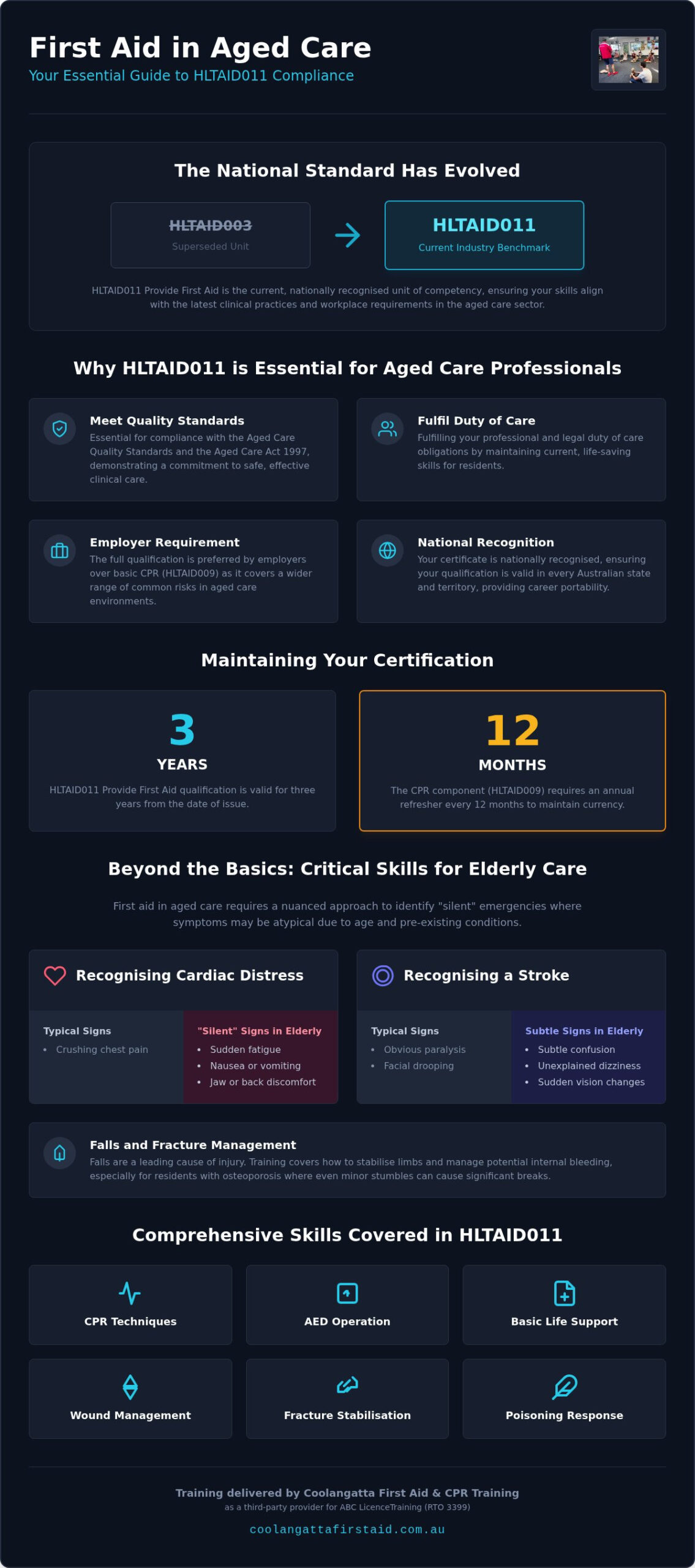
HLTAID011 Provide First Aid is the current benchmark for vocational first aid training across Australia. This unit of competency ensures that healthcare workers possess the skills to respond to a wide range of medical emergencies. It superseded the older HLTAID003 code to reflect updated clinical practices and more rigorous assessment requirements. When you book a first aid refresher course Gold Coast facilities recognise, you’re aligning your skills with the latest national standards and ensuring your qualification remains valid for the modern workplace.
Compliance in the aged care sector is governed by the Aged Care Act 1997 and the Aged Care Quality Standards. These regulations mandate that providers maintain a workforce capable of delivering safe, effective clinical care. Holding a current HLTAID011 certificate is essential for meeting these standards, particularly regarding mandatory reporting and incident management. It demonstrates that you’ve maintained the currency of your skills, which is a key component of your professional duty of care and clinical governance responsibilities.
The Legal Requirement for Care Professionals
Your duty of care obligations remain the same whether you work in a large residential facility or provide one-on-one home care. Employers almost always prioritise the full HLTAID011 qualification over the basic HLTAID009 Provide CPR unit for their permanent staff. This is because the broader qualification covers wound management, fracture stabilisation, and poisoning, which are common risks in elderly environments. One of the biggest advantages of this training is its national portability; a certificate issued through Coolangatta First Aid, as a third-party provider for ABC LicenceTraining (RTO 3399), is valid in every Australian state and territory.
Unit Components: What the Qualification Covers
The HLTAID011 unit is a comprehensive package that integrates several life-saving protocols. It includes the latest techniques for cardiopulmonary resuscitation (CPR), the correct use of an Automated External Defibrillator (AED), and basic life support (BLS) strategies. Gaining a foundational understanding of What is First Aid? helps professionals appreciate how these interventions stabilise patients until paramedics arrive. The course specifically addresses trauma management and medical emergencies tailored to the needs of elderly residents who may have complex pre-existing conditions. HLTAID011 Provide First Aid remains valid for three years from the date of issue, although the CPR component must be refreshed every 12 months to maintain full workplace compliance.
Essential Skills: Managing Elderly-Specific Emergencies
First aid in an aged care setting requires a much more nuanced approach than standard workplace training. Fragile skin, brittle bones, and the presence of complex chronic conditions mean your physical interventions must be both precise and gentle. A resident’s medical history often complicates an emergency response, making it vital to understand how pre-existing medications might mask typical symptoms or exacerbate bleeding. Attending a first aid refresher course Gold Coast workers rely on ensures you can adapt these life-saving techniques for patients who are physically vulnerable.
Identifying “silent” emergencies is a critical skill for care professionals. In senior residents, cardiac distress doesn’t always present as crushing chest pain; it might appear as sudden fatigue, nausea, or localized discomfort in the jaw or back. Similarly, a stroke may manifest as subtle confusion rather than obvious paralysis. Recognising these atypical signs is essential for meeting the Aged Care Quality Standards, which require staff to provide effective clinical care and respond rapidly to deteriorating health. Effective communication is equally vital. When a resident has dementia or hearing loss, you must use clear, short sentences and calming non-verbal cues to prevent distress from escalating during a crisis.
Falls and Fracture Management
Falls are a leading cause of injury in residential facilities, often resulting in hip fractures that carry a high risk of internal bleeding. If a resident has osteoporosis, even a low-impact stumble can cause a significant break. Your role is to stabilise the limb and manage pain without moving the patient unnecessarily. You must quickly decide whether the situation requires an immediate 000 call or if it can be managed in-house by a Registered Nurse. Understanding the facility’s specific layout and high-traffic risk zones allows you to conduct rapid risk assessments before paramedics arrive.
Choking and Respiratory Distress
Dysphagia, or difficulty swallowing, makes mealtime a high-risk period for choking incidents. You need to be confident in cleared-airway techniques that won’t cause rib fractures in a frail chest. It’s also important to distinguish between acute asthma and COPD-related respiratory distress, as the treatment protocols differ. If you have completed advanced modules, you may also be required to manage oxygen therapy equipment safely. If you feel your skills in these specific areas are getting rusty, you can refresh your qualification to ensure you’re ready for the unique challenges of the aged care environment.
Beyond the Certificate: Meeting Aged Care Quality Standards
Aged care isn’t just about daily assistance; it’s about maintaining high clinical standards every single minute. While previous sections of this guide explored identifying a crisis, the subsequent management and reporting are what keep a facility compliant with the Aged Care Quality Standards. By completing a first aid refresher course Gold Coast providers trust, you’re proving to auditors that your facility takes this mandate seriously. This training directly supports clinical governance by ensuring that every staff member can act as a first responder and follow through with accurate clinical data. It’s essential that the Nationally Recognised Training you’ve received stays sharp, especially since life-saving techniques like chest compressions require high muscle memory to be effective under pressure. Annual refreshers bridge the gap between initial certification and real-world proficiency.
Incident Reporting and Clinical Handover
When an emergency occurs, your job doesn’t end once the resident is stable. Accurate documentation is a legal requirement under the Australian Privacy Act 1988. You must record every intervention in the patient’s progress notes while maintaining strict confidentiality. This record serves as a vital piece of evidence during clinical audits and internal reviews. During a clinical handover, care professionals use the ISBAR method to communicate with emergency paramedics. This structured approach (Identification, Situation, Background, Assessment, Recommendation) ensures that no critical piece of information is lost when the resident is transferred to hospital care. Using a standardised tool like ISBAR reduces the risk of communication errors that could lead to adverse patient outcomes.
Employer Expectations and Career Progression
Facilities look for staff who go beyond the basics to ensure comprehensive safety for residents and colleagues alike. Many senior care roles now require HLTWHS005 Conduct manual tasks safely alongside first aid training to reduce the risk of back injuries during resident transfers. If you’re aiming for a management or team leader position, you might eventually need HLTAID016 Manage first aid services and resources to oversee facility-wide safety protocols. Coolangatta First Aid & CPR Training, operating as a third-party provider for ABC LicenceTraining (RTO 3399), offers these specialised units to help you build a robust professional portfolio. Keeping these certifications current doesn’t just help your career; it significantly improves your facility’s standing during external quality audits by demonstrating a commitment to continuous staff development and resident safety.
Fast-Tracking Your First Aid Certification for the Workplace
Balancing a full-time roster in aged care with your personal life makes time your most valuable asset. To accommodate this, many training organisations now offer a blended delivery mode. This allows you to complete the bulk of the theory via online modules at your own pace before attending a streamlined face-to-face practical session. Choosing a first aid refresher course Gold Coast professionals prefer means you spend less time in a classroom and more time applying practical skills that matter in a clinical setting.
The USI: Your Key to National Recognition
A Unique Student Identifier (USI) is a lifelong record of all your Australian nationally recognised training and results. You can easily create a new USI or retrieve an existing one through the government’s USI website using your driver’s licence or Medicare card. Under Australian law, a Statement of Attainment cannot be issued to a student until their USI has been successfully verified by the training provider. This ensures your qualifications are always accessible for future employers or audits.
Practical Assessment Preparation
Preparation is the best way to calm nerves about the hands-on component. You should prioritise comfortable, modest clothing like trousers or leggings and flat, closed-toe shoes. This is because the Australian Resuscitation Council (ARC) requires students to perform at least two minutes of continuous CPR on an adult manikin placed on the floor. This physical requirement is a non-negotiable part of the assessment to ensure you can perform life-saving compressions in a real-world emergency where a resident may have collapsed in a corridor or bedroom.
If you’re currently managing a physical injury or limitation, such as a knee or back issue, it’s vital to discuss this with your trainer before the session starts. While the floor-based assessment is mandatory for the HLTAID011 unit, trainers can often provide guidance on positioning to help you complete the task safely. Before you arrive, make sure to engage with the pre-course study modules and learner guides provided during enrolment. These materials ensure you’re fully prepared for the theory assessment, allowing the face-to-face time to focus on refining your technique. You can book your practical session today to start the process.
Nationally Recognised Training with Coolangatta First Aid
Choosing a training provider involves more than just finding a convenient location. It’s about ensuring your certification carries the weight of national accreditation. Coolangatta First Aid & CPR Training delivers training as a third-party provider for ABC LicenceTraining (RTO 3399), offering a family-run approach backed by professional RTO standards. This partnership ensures that every first aid refresher course Gold Coast professionals attend meets the strict regulatory requirements of the Australian Skills Quality Authority (ASQA).
The trainers at Coolangatta First Aid & CPR Training bring real-world experience from healthcare and emergency response backgrounds into the classroom. They don’t just teach theory; they share practical insights gained from years of responding to actual medical crises. This expertise is reflected in a comprehensive course range that includes HLTAID011 Provide First Aid, HLTAID009 Provide CPR, and specialised units like HLTWHS005 Conduct manual tasks safely. Because these units are nationally recognised, your Statement of Attainment is valid for any workplace across Australia, providing the mobility you need in a dynamic healthcare career.
Why Choose an RTO Partnered Provider?
Training through an RTO partnered provider guarantees that your skills align with the latest Australian Resuscitation Council (ARC) guidelines. You’ll have access to modern assessment equipment, including high-quality manikins and Automated External Defibrillators (AEDs), which simulate real-life scenarios. This high standard of training ensures that your certification is more than just a piece of paper; it’s a verified record of your ability to save lives. Additionally, the partnership with ABC LicenceTraining (RTO 3399) allows for seamless integration with national training databases, making it simple to retrieve your records for future renewals or employer audits.
Ready to Secure Your Qualification?
Aged care and disability support roles often involve complex rosters and shift work. To support this, scheduling is designed to be flexible, catering to both individuals and large facility teams. If you’re managing a residential care facility or a home care agency, group booking options are available to ensure your entire staff remains compliant with the latest Aged Care Quality Standards. Beyond the standard HLTAID011 unit, you can also access advanced modules like HLTAID015 Provide advanced resuscitation and oxygen therapy to further enhance your clinical toolkit. When you’re ready to update your skills, you can organise your HLTAID011 training with Coolangatta First Aid & CPR Training to ensure your workplace compliance is handled by experts who understand the healthcare sector.
Secure Your Professional Future in Aged Care
Maintaining your first aid certification is about more than just checking a box for your employer. It’s about ensuring you have the practical confidence to manage high-pressure situations, from identifying subtle stroke symptoms to performing effective CPR. By choosing a first aid refresher course Gold Coast professionals trust, you’re investing in your career and the safety of the residents in your care. These skills are the foundation of high-quality clinical practice and professional duty of care.
Coolangatta First Aid delivers training as a third-party provider for ABC LicenceTraining (RTO 3399), ensuring every session is fully compliant with Australian Resuscitation Council (ARC) standards. Beyond the core HLTAID011 unit, you can also access specialised training in manual handling and anaphylaxis management to round out your clinical skills. Keeping your qualifications current ensures you’re always ready to provide the best possible support to those who need it most.
Enrol in your HLTAID011 Provide First Aid course today and take the next step in your professional journey. You’ve got the passion for care; let’s make sure you’ve got the up-to-date skills to match.
Frequently Asked Questions
How long does an HLTAID011 certificate last in the aged care industry?
An HLTAID011 Provide First Aid certificate remains valid for three years from the date of issue. While the overall qualification lasts this long, the aged care industry typically requires you to refresh the CPR component much more frequently. Staying current ensures you meet the Aged Care Quality Standards and maintain workplace compliance. Most employers will prompt you to book a first aid refresher course Gold Coast providers offer well before your three-year expiry date.
Is CPR training (HLTAID009) included in the HLTAID011 course?
Yes, the HLTAID011 course fully incorporates the HLTAID009 Provide cardiopulmonary resuscitation unit. When you successfully complete the broader first aid qualification, you’ll receive a Statement of Attainment that covers both units. This comprehensive approach is why HLTAID011 is the preferred standard for healthcare professionals. It ensures you have the skills to manage everything from minor wounds to life-threatening cardiac arrests within a single training session.
Can I do my first aid refresher course entirely online for aged care?
You cannot complete a nationally recognised first aid qualification entirely online because a face-to-face practical assessment is mandatory. However, many students prefer the blended learning model. This allows you to finish the theory modules and assessments online at your own pace before attending a short practical session. This flexibility is ideal for aged care workers who need to fit their first aid refresher course Gold Coast training around demanding shift rosters.
What happens if I cannot physically perform CPR on the floor during the assessment?
The Australian Resuscitation Council (ARC) guidelines state that CPR must be performed on a manikin placed on the floor to be deemed competent. If you have a physical injury or limitation that prevents this, you should notify your trainer before the course starts. While trainers will try to provide support, the floor-based assessment is a non-negotiable requirement for the issuance of a nationally recognised HLTAID011 certificate for workplace compliance.
How often should aged care workers renew their CPR certification in Australia?
Australian health authorities and the ARC recommend that CPR certification (HLTAID009) is renewed every 12 months. Although the full HLTAID011 certificate is valid for three years, your annual CPR refresher is a critical requirement for most aged care and disability support roles. Regular practice ensures that your life-saving skills, such as chest compressions and AED usage, remain sharp and effective in a real-world emergency.
What is the difference between HLTAID011 and HLTAID012 for care workers?
HLTAID011 is the standard requirement for most workplaces and aged care settings, whereas HLTAID012 is specifically designed for education and care environments like schools or childcare centres. HLTAID012 includes additional training for asthma and anaphylaxis management tailored to children. For most aged care professionals, HLTAID011 Provide First Aid is the correct unit to meet your specific workplace health and safety obligations and industry compliance standards.
Do I need a USI to get my first aid certificate issued?
Yes, you must provide a valid Unique Student Identifier (USI) before your certificate can be legally issued. The USI is a government-mandated record of all your Australian vocational training. Without a verified USI, training providers like Coolangatta First Aid, working under ABC LicenceTraining (RTO 3399), cannot upload your results to the national database. You can easily create or find your USI on the official government website using your identification.
Will my HLTAID011 certificate be recognised by the NDIS and aged care providers?
Your HLTAID011 certificate is nationally recognised and will be accepted by the NDIS, aged care providers, and other healthcare employers across Australia. Because the training is delivered in partnership with ABC LicenceTraining (RTO 3399), it meets all regulatory requirements for vocational education. This ensures your qualification is portable, allowing you to move between different care facilities or states without needing to retrain, provided your certification remains within its validity period.
