

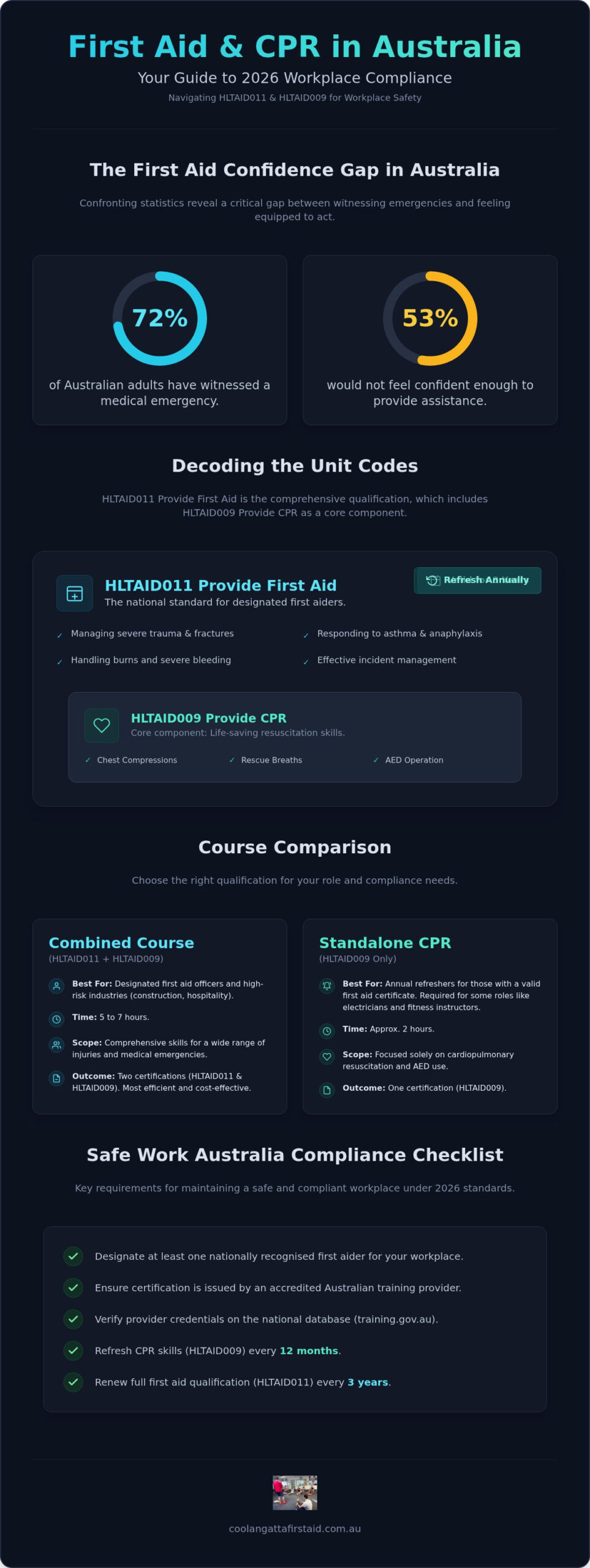
Did you know that 72% of Australian adults have witnessed a medical emergency, yet 53% wouldn’t feel confident enough to provide assistance? It’s a confronting reality that leaves many people feeling anxious about their ability to act when it matters most. If you’re looking for a first aid course Coolangatta to bridge this gap, you’ve probably noticed that the sheer number of unit codes and training requirements can be overwhelming. Between work commitments and family life, finding the time to get certified often feels like another stressor on an already full plate.
It’s completely normal to feel a bit of compliance fatigue when trying to keep up with the latest 2026 national standards. This guide will help you master the essentials of the HLTAID011 Provide First Aid unit and show you why combining first aid and CPR training is the smartest way to stay current. We’ll explore the updated ANZCOR guidelines and explain how to secure a nationally recognised certification that builds real-world confidence. By the end of this article, you’ll know exactly how to meet your workplace obligations while gaining the skills to save a life.
Key Takeaways
- Understand how the HLTAID011 unit incorporates CPR training to provide a comprehensive qualification that meets multiple workplace safety requirements.
- Learn about the 2026 Safe Work Australia standards and why having a designated, nationally recognised first aider is mandatory for all Australian workplaces.
- Discover why enrolling in a combined first aid course Coolangatta is the most time-efficient way to secure both your HLTAID011 and HLTAID009 certifications.
- Compare the flexibility of blended learning models with traditional workshops to find the training format that suits your learning style and schedule.
- Find out how to verify a training provider’s credentials on the national database to ensure your certificate is valid and professionally recognised.
Understanding the HLTAID011 and HLTAID009 Connection
Many people looking for a first aid course Coolangatta feel overwhelmed by the alphabet soup of unit codes used in Australia. You might see HLTAID011 and HLTAID009 listed separately and wonder if you need to book two different days of training. The reality is that these two units are deeply connected. HLTAID011 is the comprehensive standard for workplace safety, and it actually has the CPR component, HLTAID009, nested directly inside it. This means when you enrol in a combined course, you aren’t just doing two things at once; you’re completing a single, streamlined programme that satisfies multiple legal requirements simultaneously.
What is HLTAID011 Provide First Aid?
HLTAID011 Provide First Aid is the current nationally recognised unit for basic first aid in Australia. It serves as the baseline qualification for designated first aid officers in most industries. The course covers a wide range of essential skills, from managing severe trauma and fractures to responding to medical emergencies like asthma or anaphylaxis. You’ll also learn the basics of incident management and how to communicate effectively with emergency services. Understanding these foundational First aid principles is vital for anyone who wants to feel prepared in a crisis. Once you successfully complete this unit, your certification remains valid for three years.
The Role of HLTAID009 CPR in the Qualification
HLTAID009 Provide CPR focuses specifically on the life-saving skills of cardiopulmonary resuscitation. This includes mastering the correct depth and rhythm of chest compressions, delivering rescue breaths, and safely operating an Automated External Defibrillator (AED). While this unit is a core part of the larger first aid course, it has its own unique timeline. The Australian Resuscitation Council (ARC) recommends that CPR skills be refreshed every 12 months to ensure technique remains sharp. By completing a combined first aid course Coolangatta, you ensure that your CPR training is integrated into broader emergency scenarios. This makes the skills much easier to recall when adrenaline is high. It’s a smart, practical choice.
Australian employers almost always prefer the combined “2-in-1” approach for their staff. It’s the most efficient way to ensure workers are compliant with the Safe Work Australia Code of Practice without requiring multiple days away from the office. You’ll walk away with two distinct certifications on your transcript, proving you’re ready to handle everything from a minor workplace injury to a full cardiac arrest. This integrated training method builds a more cohesive safety mindset, as you learn how CPR fits into the wider chain of survival during a medical emergency.
Comparing Standalone CPR vs. Combined First Aid Courses
Deciding between a standalone unit and a full qualification often comes down to your specific workplace role and current certificate status. While a standalone CPR session usually takes around two hours, a comprehensive first aid course Coolangatta requires a larger investment of five to seven hours. However, the cost-effectiveness of the combined unit is significant when compared to booking separate sessions. By tackling both units at once, you save on enrolment fees and reduce the total time spent in a classroom over your three-year certification cycle. Before committing to any training option, it’s worth reviewing a detailed breakdown of the CPR course cost Gold Coast workers can expect in 2026 to ensure you’re getting genuine accredited value for your investment.
High-risk industries such as construction, hospitality, and corporate management typically mandate the full HLTAID011 Provide First Aid qualification for their designated safety officers. This is because standalone CPR lacks the depth required to manage complex trauma. While resuscitation is vital, it doesn’t prepare you for the myriad of other incidents that occur in a busy workplace, such as severe bleeding, fractures, or chemical burns. The combined course bridges this gap, providing the clinical knowledge needed to stabilise a casualty until professional medical help arrives.
When is Standalone CPR (HLTAID009) Sufficient?
There are specific scenarios where a shorter session is the appropriate choice. If you already hold a valid first aid certificate, you only need to complete a CPR refresher every 12 months to remain compliant with national standards. This annual update is a mandatory requirement for certain professionals, including electricians who need it for their low voltage rescue renewals and fitness instructors who must maintain current resuscitation skills for their professional registration. It’s a focused way to ensure your technique remains sharp without repeating the entire first aid syllabus.
The Strategic Advantage of the Combined Course
Choosing the combined path offers a strategic advantage for your long-term career. You’ll gain mastery over 20 different medical conditions and injury types, ranging from snake bites to diabetic emergencies. This level of preparation is essential in high-stress environments where you might be the only person capable of providing immediate care. Holding the higher-level qualification also provides greater flexibility if you decide to change industries, as it’s the most widely accepted standard for workplace safety across Australia. If you’re ready to upgrade your skills, you can view our full range of safety units to find the right fit for your career goals.
Workplace Compliance and National Training Standards in 2026
National safety standards ensure every worker has access to life-saving care, regardless of their industry. The Safe Work Australia “First Aid in the Workplace Code of Practice” was updated for 2026, setting clear expectations for Australian businesses regarding their duty of care. Compliance isn’t just about ticking a box; it’s a legal obligation under the Work Health and Safety Act 2011. Safety is non-negotiable. To meet these National Training Standards for HLTAID011, employers must ensure their designated responders are trained through a Registered Training Organisation (RTO). When you’re searching for a first aid course Coolangatta, verifying that the provider operates via a third-party partnership with an established RTO, such as RTO 3399, is the first step toward legitimate certification.
Meeting Safe Work Australia Requirements
Under the 2026 code, the number of trained staff you need depends on your environment’s risk level. For low-risk workplaces, you’ll need at least one first aider for every 50 workers. High-risk environments, like construction sites or manufacturing plants, require a higher ratio of one first aider per 25 workers. It isn’t enough to just have the staff; your kits and facilities must also reflect the specific risks identified in your workplace risk assessment. Employers are legally bound to provide accredited training, ensuring that when an emergency happens, the response is competent and controlled. This ensures that the person providing help has the most recent skills to manage a crisis until paramedics arrive.
The Australian and New Zealand Committee on Resuscitation (ANZCOR) released updated guidelines in February 2026. These changes specifically refine how we handle post-resuscitation care and anaphylaxis first aid, reflecting the latest clinical evidence. Accuracy saves lives. Staying current with these nuances is why choosing a provider that strictly follows these latest ARC standards is vital for workplace safety. Completing a first aid course Coolangatta through a family-run provider ensures you receive expert instruction tailored to these national benchmarks.
The Significance of Nationally Recognised Training (NRT)
Always look for the Nationally Recognised Training (NRT) logo on your certificate. This symbol confirms that your training meets the rigorous quality standards of the Australian Skills Quality Authority (ASQA). Your 2026 certification is linked to your Unique Student Identifier (USI), which records:
- Your completed units of competency.
- The date of your assessment.
- The RTO responsible for your training.
This creates a permanent, digital record of your qualifications that follows you throughout your career, making it easy for future employers to verify your skills instantly. For a deeper look at the curriculum and what you’ll learn during your session, see our guide on HLTAID011 Provide First Aid.
Choosing the Right Training Format for Your Schedule
Finding time for a first aid course Coolangatta shouldn’t be a hurdle to workplace safety. In 2026, training providers offer several formats to suit different learning styles and professional backgrounds. Whether you’re a first-time learner or a seasoned professional needing a quick update, choosing the right delivery method ensures you gain the necessary confidence without wasting hours in a classroom. The modern approach to safety training prioritises flexibility while maintaining the rigorous standards required for national certification.
Blended vs. Face-to-Face Learning
The blended learning model has become the most popular choice for busy Australians. This format allows you to complete the theoretical component via an online portal at your own pace before attending a shorter, focused practical session. It’s an ideal solution if you prefer to digest information in smaller chunks or have limited availability during business hours. Traditional full-day workshops remain the gold standard for beginners who benefit from immediate instructor feedback and the opportunity to ask questions as they go. While theory can be learned remotely, hands-on practice is non-negotiable for mastering life-saving techniques. National training standards mandate that practical assessments for HLTAID011 must include at least two minutes of continuous CPR on an adult manikin placed on the floor.
What to Expect During the Practical Assessment
Practical assessments are designed to simulate real-world emergencies. You’ll be required to demonstrate your skills on both adult and infant manikins, ensuring you can adapt your technique for different age groups. It’s worth understanding that the techniques used for infants differ significantly from those for adults — if you’re a parent or carer, our guide on infant CPR Gold Coast myths and 2026 ARC guidelines can help you feel more confident before your practical session. Physical readiness is important, as you must be able to perform chest compressions while kneeling on the floor. Beyond resuscitation, you’ll engage in scenario-based tasks such as applying pressure bandages for heavy bleeding, using an EpiPen for anaphylaxis, and managing a simulated asthma attack. These exercises move the training from abstract concepts to muscle memory. For many workers, the same-day certificate is the most valuable outcome, providing immediate proof of compliance for their employer. If you’re ready to get certified, you can check our upcoming course dates to find a session that works for you.
For those who already hold a current and valid certificate, the “Express” or “Refresher” format offers a streamlined path to renewal. These sessions skip the introductory theory and focus purely on updated 2026 ARC guidelines and practical competency. This ensures that experienced first aiders don’t spend time on concepts they’ve already mastered, focusing instead on the subtle technique changes that save lives in high-pressure situations. Regardless of the format you choose, the end goal is a nationally recognised qualification that gives you the power to act when an emergency occurs.
Enrolling with an Accredited Australian Training Provider
Selecting a provider for your first aid course Coolangatta is a decision that impacts your professional liability and personal confidence. Before you commit to a training date, it’s essential to verify that the organisation is legitimate. You can do this by visiting the training.gov.au database, which serves as the national register for Vocational Education and Training (VET) in Australia. Checking a provider’s credentials ensures your certificate won’t be rejected by an employer or a regulatory body later. Choosing a family-run business offers a distinct advantage; you receive the personalised attention of expert instructors who understand the specific safety challenges of the Australian workforce.
Why Training with an RTO Partner Matters
A safety certificate is only as strong as the organisation that backs it. Coolangatta First Aid & CPR Training operates as a trusted third-party provider for ABC LicenceTraining (RTO 3399), ensuring that every student receives training that’s valid in every state and territory. Registered Training Organisations (RTOs) must undergo rigorous and regular auditing to maintain their status. This process ensures the equipment, training materials, and assessment methods meet strict national benchmarks. By choosing a provider with a verified RTO partnership, you’re guaranteed that your qualification is nationally recognised and meets the high standards required for workplace compliance.
Preparation is the key to a smooth and successful training day. Before you arrive at the training centre, ensure you’ve finalised your Unique Student Identifier (USI) setup. While your USI serves as a permanent record of your achievements, having it ready before you start prevents delays in issuing your certification. If you’ve opted for a blended learning programme, carve out dedicated time to engage with the pre-reading materials. This groundwork allows you to spend your face-to-face session focusing on the practical, life-saving techniques that matter most in a real-world emergency.
Beyond the Basics: Specialised Safety Training
Once you’ve mastered the essentials of your first aid course Coolangatta, you might consider expanding your expertise with advanced units. For those working in high-risk environments, units like HLTAID015 Provide advanced resuscitation and oxygen therapy or UETDRMP018 Perform rescue from a live low voltage panel are logical next steps. These advanced certifications build on the foundational skills you’ve already acquired, making you an even more versatile and valuable member of your workplace safety team.
If you’re working in the education sector, the ACECQA-approved HLTAID012 Provide First Aid in an Education and Care Setting is often a mandatory requirement. This unit addresses specific risks associated with children and infants that aren’t always covered in depth during standard courses. You can learn more about the curriculum and assessment requirements in our Childcare First Aid Refresher guide. Staying ahead of national safety standards is an ongoing commitment to the well-being of those around you. Enrol in a comprehensive programme to secure your workplace safety credentials today.
Secure Your Future Readiness with National Certification
Mastering the skills within the HLTAID011 unit provides more than just a certificate; it gives you the power to act when seconds count. By choosing a combined programme, you ensure that your resuscitation techniques and trauma management skills are perfectly aligned with the 2026 ARC guidelines. Whether you need to meet workplace ratios or simply want to protect your family, enrolling in a first aid course Coolangatta is the most efficient way to achieve lasting compliance.
Our training is delivered through a third-party partnership with ABC LicenceTraining (RTO 3399), ensuring your qualification is recognised across Australia for three years. You’ll learn from expert trainers with real-world emergency experience who focus on building your confidence through hands-on practice. Don’t wait for an emergency to realise you’re unprepared. Book Your Nationally Recognised First Aid and CPR Course Today and join the group of Australians who are truly ready to save a life. It’s a decision that could make all the difference.
Frequently Asked Questions
Is the HLTAID011 Provide First Aid course the same as Senior First Aid?
Yes, HLTAID011 is the current national unit that has superseded older names like Senior First Aid or Level 2 First Aid. It’s the standard qualification required for most Australian workplaces. If you’re looking for a first aid course Coolangatta, you’ll find that HLTAID011 covers the comprehensive skills needed to manage various medical emergencies. While the terminology has evolved over the years, the core purpose of training individuals to respond effectively remains the same.
Can I complete a first aid and CPR combined course entirely online?
No, you cannot get a nationally recognised certification through a 100% online course. While you can complete the theoretical component and multiple-choice questions via an online portal, national training standards require a face-to-face practical assessment. You must demonstrate physical competency, such as performing CPR on a manikin, in front of a qualified assessor to prove you can apply these life-saving skills in a real-world emergency where every second counts.
How long does the combined first aid and CPR certificate remain valid?
The HLTAID011 Provide First Aid component of your certificate is valid for three years from the date of issue. However, the CPR component (HLTAID009) must be refreshed every 12 months to remain compliant with Australian Resuscitation Council (ARC) guidelines and most workplace safety regulations. When you book a first aid course Coolangatta, your trainer will usually provide a combined transcript that clearly lists the expiry dates for both units to help you stay compliant.
What is the difference between HLTAID011 and HLTAID012 for childcare workers?
HLTAID011 is the general workplace first aid standard, whereas HLTAID012 Provide First Aid in an Education and Care Setting is specifically designed for those working with children. HLTAID012 includes additional training on asthma and anaphylaxis management tailored to infants and small children. It’s approved by ACECQA as meeting the specific legislative requirements for childcare centres, preschools, and family day care environments where specialised skills are needed to ensure the safety of young ones.
Do I need to perform CPR on the floor to pass the assessment?
Yes, the national assessment requirements for HLTAID011 and HLTAID009 state that students must perform at least two minutes of uninterrupted CPR on an adult manikin placed on the floor. This requirement ensures that you are physically capable of performing the task in a real emergency where casualties are rarely found on tables. If you have physical limitations or injuries, it’s best to discuss these with your trainer before the training session begins.
How often should I refresh my CPR certification in Australia?
You should refresh your CPR certification every 12 months. While the broader first aid qualification lasts for three years, the Australian Resuscitation Council (ARC) recommends annual CPR updates to ensure your technique remains sharp and effective. Regular refreshers are crucial because resuscitation skills are low frequency but high stakes, meaning they can easily be forgotten if they aren’t practiced or reviewed through an accredited training provider at least once a year.
What is a USI and why do I need one for my first aid course?
A Unique Student Identifier (USI) is your individual education number that stays with you for life. It’s a mandatory requirement for anyone undertaking nationally recognised training in Australia. Your USI allows all your training records and results to be safely stored in one central online account. Without a valid USI, your training provider cannot legally issue your statement of attainment for essential units like HLTAID011 or HLTAID009.
Will my first aid certificate be recognised by my employer across different states?
Yes, because the units are nationally recognised, your certificate is valid in every state and territory across Australia. Whether you complete your training in Queensland, New South Wales, or Victoria, the HLTAID011 unit meets the same national standards. This portability is a key benefit of the Australian Vocational Education and Training (VET) system, allowing workers to move between states without needing to retrain for basic workplace safety compliance or job applications.
