
What if the very techniques you learned to save an adult’s life could actually be ineffective, or even dangerous, when applied to a tiny infant? It’s a terrifying thought that keeps many parents and carers awake at night, especially when they’re searching for reliable infant CPR Gold Coast training but feel bogged down by conflicting advice from social media.
It’s completely normal to feel a sense of dread about the possibility of causing harm to a small baby during an emergency. We understand that the pressure to get it right is immense, and the fear of doing it wrong often leads to hesitation when seconds matter most. This article will help you replace that anxiety with competence by debunking the most persistent and dangerous myths about baby resuscitation.
You’ll discover the critical differences between adult and paediatric care and gain a clear understanding of the 2026 Australian Resuscitation Council (ARC) guidelines. We’ll preview the essential skills required for national certification, such as the two-thumb encircling technique, ensuring you have a clear path to gaining the confidence needed to protect the littlest members of your family.
Key Takeaways
- Learn why infants require unique resuscitation techniques and why treating them like “small adults” is a dangerous misconception.
- Master the neutral head position and the two-thumb compression technique to ensure you are following the 2026 Australian Resuscitation Council guidelines.
- Understand the DRSABCD protocol specifically adapted for babies, including how to check for a response without causing harm.
- Gain the confidence to act by choosing hands-on training for infant CPR Gold Coast rather than relying solely on online videos.
- Identify the correct national certification for your needs, such as HLTAID012 for those working in Australian education and care settings.
Common Myths: Why Infant CPR Knowledge is Often Misunderstood
Misinformation can be just as dangerous as inaction during a medical emergency. Many people mistakenly believe that adult resuscitation techniques are universal, but applying adult-strength force to a newborn can lead to serious complications. This is why seeking accredited training for infant CPR Gold Coast is vital for anyone caring for young children. Understanding the nuances of baby-specific care ensures you don’t rely on outdated or incorrect assumptions.
- Myth 1: You can use the same technique for babies as you do for adults. Truth: Infants have fragile airways and smaller frames. Using two hands for compressions or a full head tilt can cause internal injuries or block the airway entirely.
- Myth 2: You should wait for paramedics before starting chest compressions. Truth: Brain damage can begin in as little as four minutes without oxygen. You are the critical link in the chain of survival while help is on the way.
- Myth 3: CPR will always “restart” a heart instantly. Truth: Real-life resuscitation isn’t like the movies. CPR is designed to manually pump blood and oxygen to the brain, keeping the person viable until professional medical intervention or a defibrillator can be used.
- Myth 4: Mouth-to-mouth is no longer required for infants. Truth: While “hands-only” CPR is popular for adults, it’s rarely appropriate for babies.
The Danger of “Compression-Only” Thinking for Babies
Current public health campaigns often promote compression-only CPR for adults to encourage bystanders to act. While this works for sudden cardiac events in adults, it’s often inadequate for infants. Most paediatric arrests are caused by respiratory failure, meaning the baby has run out of oxygen before their heart stopped. Following the principles of Pediatric Basic Life Support (PBLS), rescuers must provide rescue breaths to get oxygen back into the bloodstream. When attending an infant CPR Gold Coast course, instructors will emphasise that for a baby, breaths are a non-negotiable part of the process.
Fear of Injury vs. The Necessity of Action
A common barrier to starting compressions is the fear of breaking a baby’s ribs. It’s a valid concern, but it’s misplaced. An infant’s ribcage is significantly more flexible and cartilaginous than an adult’s, meaning it can withstand the pressure of compressions better than you might think. While a fracture is a possibility, it’s a minor injury compared to the alternative. If you don’t act, the outcome is certain. Action beats hesitation every single time. Your goal is to keep blood flowing to the brain, and a flexible ribcage is designed to handle that depth of compression.
The Science of Small: Why Anatomy Dictates Technique
In the Australian first aid framework, an “infant” is defined as any child under 12 months of age. This distinction is critical because the physiological makeup of a baby is vastly different from that of an adult or even an older child. Their bones are softer, their airways are narrower, and their heart rates are naturally much faster. The Australian Resuscitation Council (ARC) sets national standards based on these anatomical realities to ensure that rescuers provide the best possible care without causing unnecessary harm. When you enrol in a course for infant CPR Gold Coast, you aren’t just learning a smaller version of adult first aid; you’re learning a specialised science designed for the most fragile patients.
Managing the Fragile Infant Airway
An infant’s trachea is about the width of a drinking straw and is incredibly soft and pliable. In an adult, we perform a full head tilt and chin lift to open the airway, but doing this to a baby can be counterproductive. Over-extending a baby’s neck can actually kink the airway, much like folding a garden hose, which completely blocks the flow of air. Instead, the ARC guidelines require a “neutral position” to keep the passage clear during rescue breaths. While international guides like the American Red Cross infant CPR steps offer similar advice, the focus here is on the specific delicacy required for Australian standards.
The neutral position is achieved by keeping the infant’s head level with their body so their face is parallel to the ground, ensuring the neck is neither tilted back nor tucked forward.
Circulation and Compression Mechanics
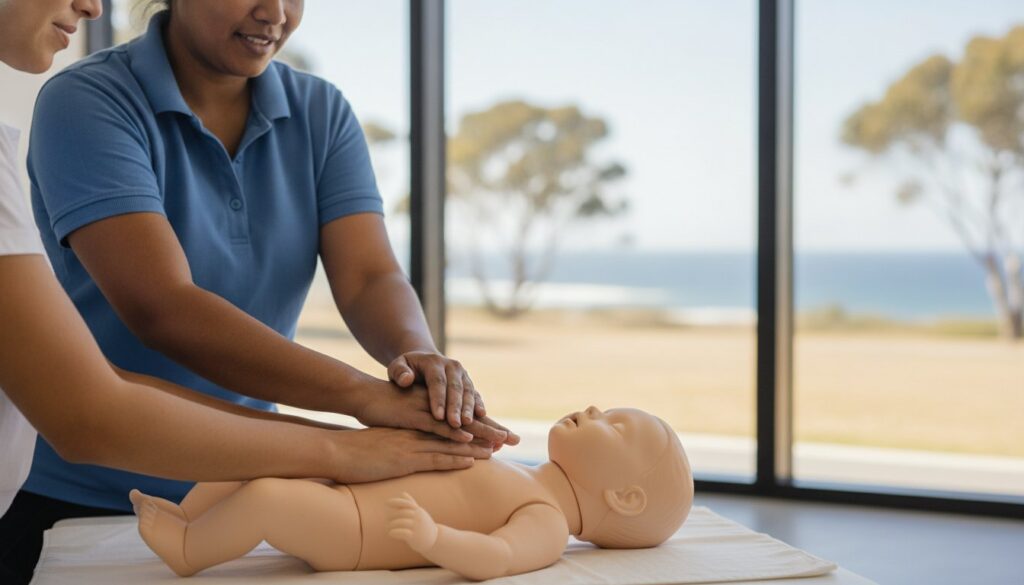
The mechanics of pumping an infant’s heart require precision rather than power. Because the chest is small and the heart sits relatively high, the technique involves using two fingers or the two-thumb encircling method on the lower half of the breastbone. The target depth is exactly one-third of the chest cavity, which equates to approximately 4cm in most infants. This depth is essential to physically squeeze the heart against the spine to circulate blood. You must maintain a brisk pace of 100 to 120 compressions per minute, which is the same “Stayin’ Alive” rhythm used for adults, but with significantly less surface area and force.
Understanding these anatomical requirements is the first step toward competence, but reading about them is very different from performing them under pressure. To truly master these life-saving skills, you should consider booking into an accredited training course where you can practice on infant-specific manikins. This hands-on experience builds the muscle memory that ensures you’ll know exactly how 4cm of depth feels before an emergency ever occurs.
Infant vs. Adult CPR: Key Differences You Must Recognise
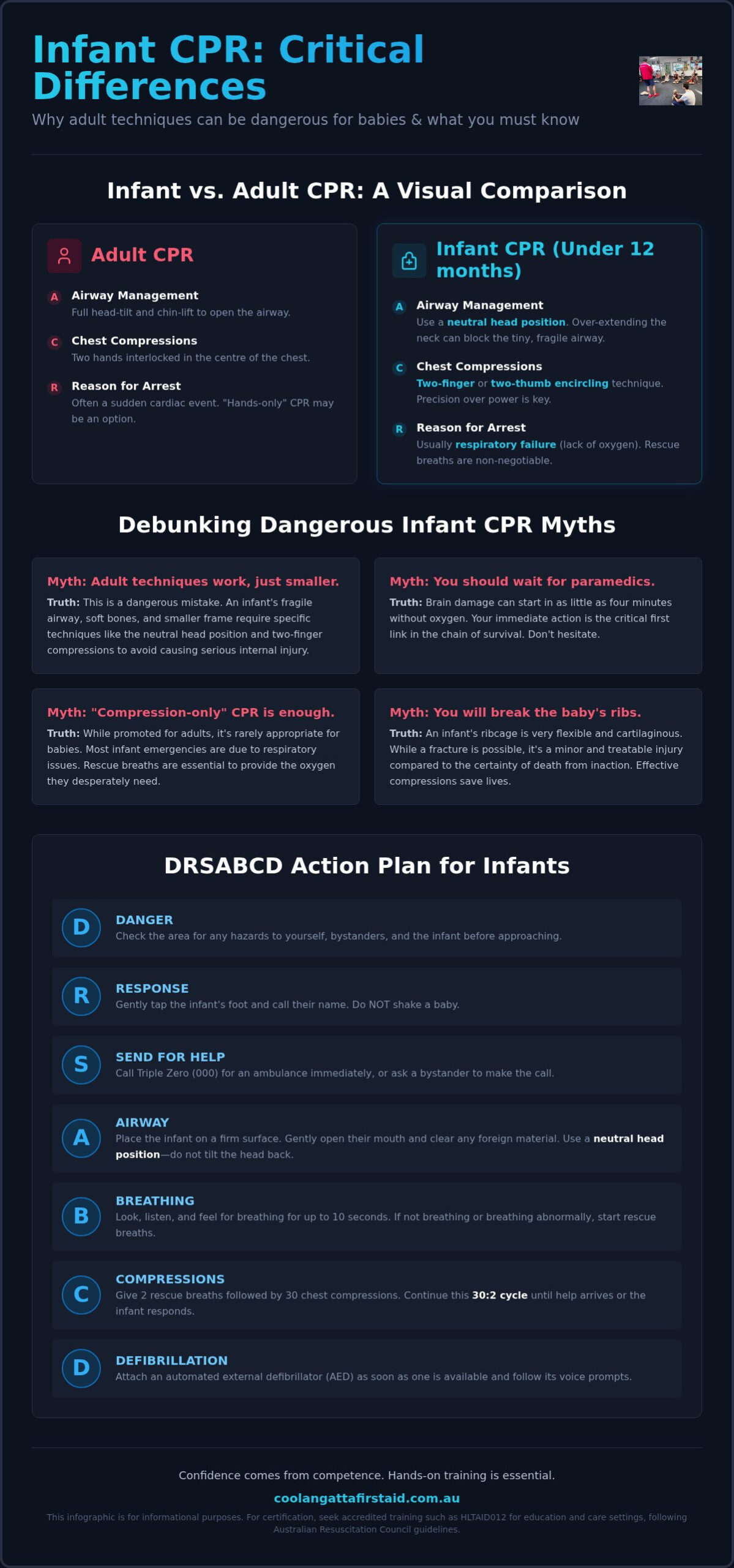
While the fundamental goal of cardiopulmonary resuscitation remains the same across all ages, the physical application changes dramatically when transitioning from an adult to a baby. Using adult-style force on an infant isn’t just ineffective; it can be catastrophic. Understanding these distinctions is a core component of any infant CPR Gold Coast training program, as it ensures rescuers don’t accidentally cause secondary injuries during a crisis.
The differences are most apparent in four specific areas of the DRSABCD protocol:
- Hand Placement: For adults, you use two interlocking hands in the centre of the chest. For infants, you use two fingers or the two-thumb encircling technique to accommodate their smaller surface area.
- Head Tilt: Adults require a full head tilt and chin lift to clear the airway. Infants must remain in a neutral position to prevent the soft trachea from kinking.
- Rescue Breaths: An adult requires a full breath from the rescuer’s lungs. An infant only needs a small puff of air from the rescuer’s cheeks.
- Compression Depth: Adult compressions target 5 to 6cm of depth. Infant compressions must be limited to approximately 4cm, or one-third of the chest depth.
Ventilation Techniques for Tiny Lungs
The way we deliver oxygen to an infant is a significant departure from adult protocols. Because a baby’s face is so small, a rescuer cannot easily pinch the nose and cover the mouth separately. Instead, you must create a seal over both the mouth and the nose simultaneously with your own mouth. This “mouth-and-nose” seal ensures that no air escapes during the ventilation phase.
The volume of air used is equally important. You aren’t taking a deep breath and blowing; you are simply using the air already in your mouth to deliver a gentle puff. Over-inflating an infant’s lungs can lead to pressure-related injuries or cause air to enter the stomach, which often results in vomiting and further airway complications. Precision is always more important than volume.
The 30:2 Ratio Across the Lifespan
Despite the technical differences in how you push and breathe, the timing remains consistent. The Australian Resuscitation Council maintains the 30:2 ratio as the national standard for all ages. This means you deliver 30 compressions followed by 2 rescue breaths, repeating the cycle until professional help arrives or the baby recovers. Coordinating this alone can be exhausting, so it’s vital to focus on high-quality compressions while maintaining that steady rhythm.
If you’re interested in how these techniques integrate with broader emergency care, reviewing a combined first aid and CPR course, such as the comprehensive programs from Siren Training, can provide a more holistic view of life-saving skills. Mastering these differences during an infant CPR Gold Coast workshop allows you to switch gears instantly if you ever need to provide care to a child rather than an adult.
<h2 id=
The DRSABCD action plan is the universal framework for emergency response in Australia. While the acronym is the same for all ages, the way you move through each step for a baby requires specific, gentle adjustments. Mastering this sequence during a course for infant CPR Gold Coast ensures that you don’t skip critical life-saving steps when adrenaline is high. Seconds count, and having a memorised plan allows you to act with precision.
- Danger: Check the area for hazards like water, electricity, or traffic. Ensure the environment is safe for you, the baby, and any bystanders.
- Response: Look for any signs of movement or consciousness.
- Send for Help: If there is no response, call 000 or 112 immediately. If someone is with you, tell them specifically to call and come back to confirm.
- Airway: Ensure the infant is on a firm, flat surface and maintain a neutral head position.
- Breathing: Look, listen, and feel for normal breathing for no more than 10 seconds.
- CPR: If the baby isn’t breathing or is gasping, start 30 compressions followed by 2 breaths.
- Defibrillation: Apply an Automated External Defibrillator (AED) as soon as it is available.
Checking for a Response Safely
When an infant is unresponsive, the instinct to shake them to wake them up is powerful, but it must be resisted at all costs. Shaking a baby can lead to Shaken Baby Syndrome, causing permanent brain damage or even death due to the fragility of their neck muscles and brain tissue. Instead, check for a response by flicking the sole of their foot or gently squeezing their shoulder while calling their name. If the baby is breathing but remains unconscious, place them in the recovery position. For an infant, this means holding them on their side in your arms or on a flat surface, ensuring their head remains in a neutral position so the airway stays open. To learn these physical transitions correctly, you should book your practical assessment with a qualified instructor.
Using an AED on an Infant
Many people wrongly believe that AEDs are only for adults. In reality, an AED can and should be used on an infant if they are in cardiac arrest. Most modern AEDs come with paediatric pads or a “paediatric mode” that reduces the energy level of the shock to suit a smaller heart. If only adult pads are available, the 2026 Australian Resuscitation Council guidelines confirm they can still be used. Because an infant’s chest is so small, you cannot place both pads on the front as they might touch and short-circuit. Instead, use the “front and back” placement: one pad in the centre of the chest and the other in the centre of the back. This ensures the current passes directly through the heart. This life-saving skill is a major focus in infant CPR Gold Coast training, as it significantly increases the chances of survival.
Why National Cardiopulmonary Resuscitation Certification Matters
Watching a video on social media might give you a basic idea of what to do, but it cannot replicate the physical sensation of performing life-saving techniques. There is a profound difference between observing a skill and developing the muscle memory required to execute it under pressure. During an infant CPR Gold Coast workshop, you engage with specialised manikins that provide real-time feedback on your compression depth and ventilation volume. This hands-on practice ensures that if you ever need to act, your body knows what to do even when your mind is racing.
National certification isn’t just a piece of paper; it’s evidence that you’ve been trained to the current standards set by the Australian Resuscitation Council. For parents, grandparents, and professional carers, this formal training provides a level of peace of mind that informal workshops simply cannot offer. You leave the session knowing you’ve mastered the 2026 guidelines, from the neutral head position to the specific “front and back” AED pad placement discussed earlier. This structured learning environment allows you to ask questions and correct your technique before a real-life emergency occurs.
Choosing the Right Course for Your Needs
Selecting the correct unit of competency depends on your specific role and environment. While HLTAID009 focuses purely on resuscitation, many choose to complete HLTAID011 Provide First Aid for a broader understanding of medical emergencies. If you work in a nursery, preschool, or any early childhood setting, the nationally recognised HLTAID012 unit is the essential industry requirement. Professionals in these fields often find that a childcare first aid refresher is the best way to keep their specialised skills current and compliant. Before enrolling, it’s worth understanding the CPR course cost Gold Coast providers charge so you can compare accredited options and ensure you’re receiving genuine value for your certification. For parents, opting for an accredited infant CPR Gold Coast course ensures you’re receiving the same high-quality instruction as those in the medical and education sectors.
Maintaining Your Certification
First aid guidelines are not static. They evolve as new medical research emerges, which is why staying up to date is vital for safety. While most first aid certificates remain valid for three years, the industry standard and ARC recommendation is that CPR skills should be updated every 12 months. This annual update ensures your technique remains sharp and your knowledge of the latest protocols is fresh. You can easily book a CPR refresher to maintain your compliance and confidence. Regular practice is the only way to ensure that your response remains instinctive rather than hesitant when a baby’s life is on the line.
Empower Yourself with Life-Saving Skills
Understanding that infants require a specialised response is the first step toward becoming a confident rescuer. By debunking common myths and mastering the 2026 ARC guidelines, you’ve already shifted from fear to awareness. Remember that the neutral head position and precise 4cm compression depth are critical anatomical requirements that separate baby resuscitation from adult techniques. These skills are best refined through hands-on practice where you can build the muscle memory needed to act decisively.
If you’re ready to gain the confidence to protect the littlest members of your community, securing your infant CPR Gold Coast certification is the next logical move. Coolangatta First Aid & CPR Training provides accredited HLTAID009 and HLTAID012 courses led by experienced trainers with real-world expertise. With same-day certificate issuance available, there’s no reason to delay your training. Book your nationally recognised CPR training today and ensure you’re prepared for any emergency. Your willingness to learn could one day be the difference that saves a life.
Frequently Asked Questions
Is infant CPR the same as adult CPR?
No, the techniques for infants are significantly different. Rescuers must use a neutral head position rather than a full head tilt to keep the airway open. Compressions are performed using two fingers or thumbs instead of two hands, and breaths are delivered as gentle puffs from the cheeks. These modifications protect the infant’s fragile anatomy while ensuring oxygen still reaches the brain.
Can I use an AED on a baby under 12 months old?
Yes, you can and should use an automated external defibrillator if a baby is in cardiac arrest. Ideally, you should use paediatric pads or a machine with a paediatric setting to deliver a lower energy shock. If only adult pads are available, place one in the centre of the chest and one in the centre of the back so they don’t touch.
What is the correct depth for chest compressions on an infant?
The correct depth is approximately one-third of the chest cavity, which is about 4cm for most babies. This depth is necessary to physically pump the heart and maintain circulation. Mastering this specific pressure is a key part of infant CPR Gold Coast training, as it helps rescuers overcome the fear of causing injury while ensuring the compressions are effective.
How do I check if a baby is responsive without shaking them?
You should check for a response by flicking the sole of the baby’s foot or gently squeezing their shoulder while calling their name. Never shake an infant, as their neck muscles are weak and their brain tissue is fragile; shaking can lead to permanent neurological damage. If the baby does not move, cry, or react, you must immediately progress to calling 000 and checking their breathing.
Do I need a special certificate for childcare first aid?
Yes, those working in the education and care sector usually require the HLTAID012 Provide First Aid in an Education and Care Setting certification. This accredited unit covers all the standard first aid and CPR protocols but includes additional, mandatory training for managing asthma and anaphylaxis in children. It’s the industry standard for childcare workers and preschool teachers across Australia.
What happens if I accidentally break a baby’s rib during CPR?
While an infant’s ribs are very flexible and fractures are rare, you must continue with compressions even if you suspect an injury. A broken rib is a manageable medical issue, whereas cardiac arrest is fatal without intervention. Your primary goal is to keep the brain alive by circulating oxygenated blood. Professional medical staff will address any secondary injuries once the baby is stabilised.
Should I call 000 before or after starting CPR on an infant?
You should call 000 as soon as you realise the infant is unresponsive and not breathing. If you are alone, put your phone on speakerphone so you can talk to the emergency operator while you begin the DRSABCD protocol. If another person is available, instruct them to make the call and find an AED while you stay with the baby to start compressions immediately.
How often do I need to renew my CPR certification in Australia?
The Australian Resuscitation Council recommends that you refresh your CPR skills every 12 months to maintain proficiency. Although a full first aid certificate like HLTAID011 or HLTAID012 lasts for three years, the CPR component (HLTAID009) expires annually. Many parents and professionals book an infant CPR Gold Coast refresher every year to ensure their life-saving techniques remain sharp and compliant with national standards.
