
If you believe your CPR skills from a few years ago are still sharp enough to save a life, the Australian Resuscitation Council has some sobering news for you. Most people find their confidence and technique begin to fade long before their certificate actually expires. We understand that booking a CPR refresher Gold Coast session can feel like just another chore on your to-do list. You’re likely worried about whether you’ve got the right course code or if you’ll have to sit through hours of repetitive theory modules you’ve already mastered.
It’s completely normal to feel a bit of pressure about the physical assessment on the manikin, but staying compliant shouldn’t be stressful. This guide is designed to help you organise your 2026 HLTAID009 certification with zero fluff and maximum practical value. We’ll show you exactly how to prepare for your session, what to expect during the assessment, and how to ensure you receive your nationally recognised Statement of Attainment without delay. By the end of this checklist, you’ll have the confidence to step into your training centre and walk out with your skills fully restored.
Key Takeaways
- Understand why HLTAID009 is the essential current unit for CPR, ensuring your certification meets the latest national standards and workplace requirements.
- Prepare your Unique Student Identifier (USI) and valid identification in advance to ensure a smooth booking process for your CPR refresher Gold Coast.
- Select between traditional face-to-face sessions or time-saving blended learning formats based on your previous experience and schedule.
- Master the assessment requirements, including the DRSABCD protocol and two minutes of continuous compressions, to guarantee a successful practical demonstration.
- Verify that your chosen course offers same-day certificate issuance to stay compliant without waiting weeks for your paperwork.
Understanding the HLTAID009 CPR Refresher Requirements
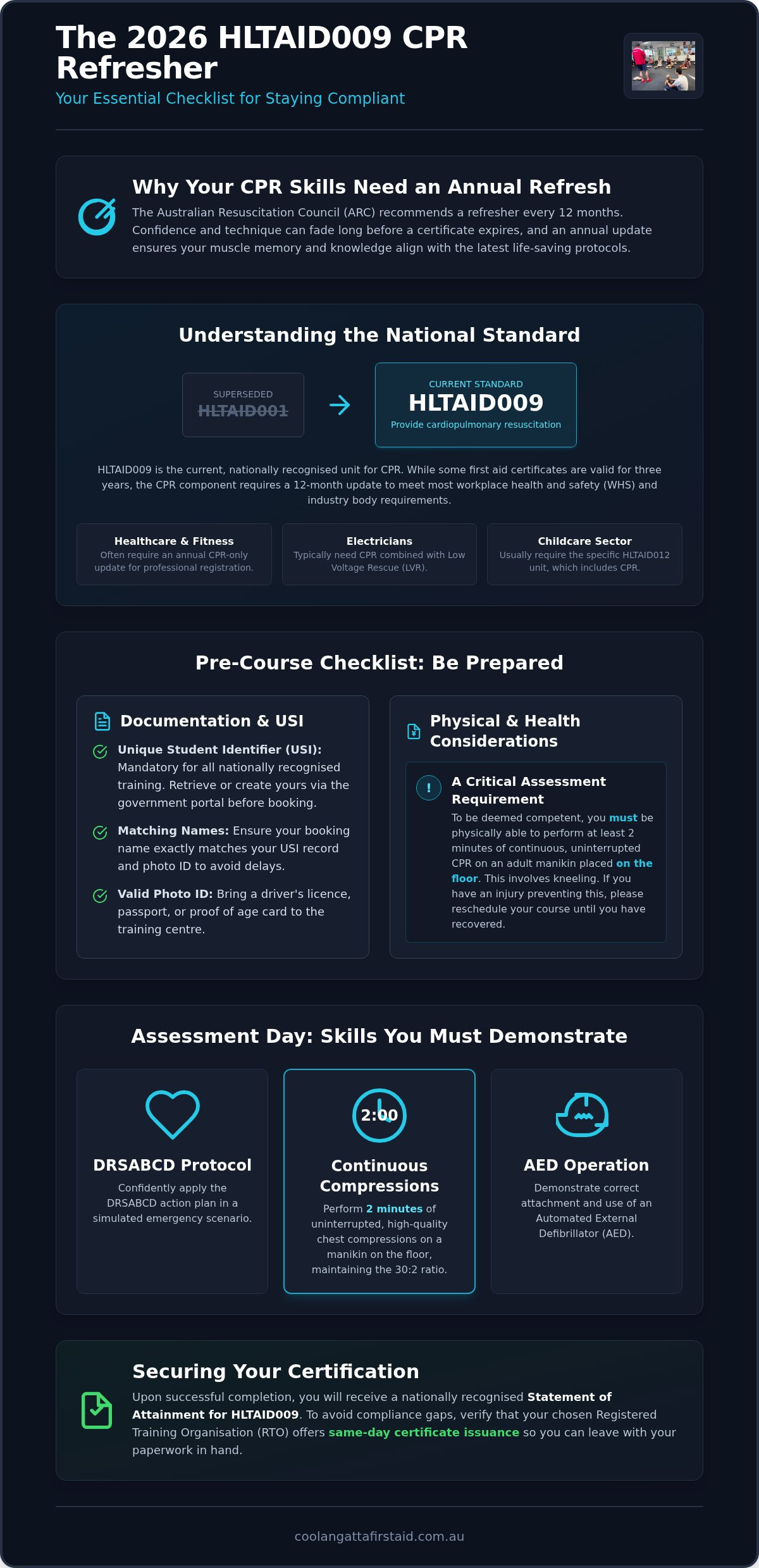
Identifying the correct unit code is the first step toward staying compliant in any Australian workplace. HLTAID009 Provide cardiopulmonary resuscitation is the current nationally recognised standard, having superseded the older HLTAID001 code. While your broader first aid certificate might technically remain valid for three years, the Australian Resuscitation Council (ARC) and most peak industry bodies recommend a refresher every 12 months. This annual update ensures your muscle memory remains sharp and your knowledge aligns with the latest 2026 protocols. For those booking a CPR refresher Gold Coast, focusing on this specific unit keeps you compliant with workplace health and safety codes and industry-specific regulations across the country.
Is HLTAID009 the Right Unit for You?
Before you book, confirm whether your industry requires just the CPR component or a broader qualification. Many healthcare professionals and fitness instructors only need the annual CPR update to maintain their professional registration. However, if you’re in a general workplace, you might actually need HLTAID011 Provide First Aid, which includes the CPR unit but is only refreshed every three years. Electricians often require a combination of CPR and Low Voltage Rescue (LVR) to meet WHS requirements. Similarly, those in the early childhood sector usually need HLTAID012. If your previous certificate was issued within the last year, you’re in the perfect window for a fast-tracked refresher session rather than a full beginner course.
National Standards and ARC Guidelines in 2026
The 2026 standards for Cardiopulmonary resuscitation (CPR) prioritise high-quality chest compressions and the rapid integration of an Automated External Defibrillator (AED). Current ARC guidelines maintain the 30:2 ratio, but the focus has shifted toward minimising interruptions to compressions and ensuring correct depth and recoil. Training with a Registered Training Organisation (RTO) ensures you’re learning these exact techniques on modern manikins that provide real-time feedback on your performance. This isn’t just about ticking a box; it’s about mastering the “refresher” mindset. By focusing on the latest high-performance techniques, a CPR refresher Gold Coast session transforms a routine requirement into a streamlined audit of your life-saving capabilities. Professionals in nursing, education, and electrical trades rely on these annual updates to meet AHPRA or WHS requirements, ensuring they can act decisively in any emergency.
Pre-Course Checklist: What You Need Before Booking
Preparing for your CPR refresher Gold Coast involves more than just showing up on the day. To ensure your training runs smoothly and your certificate is issued without delay, you need to have your documentation and physical readiness sorted in advance. The HLTAID009 assessment is a practical, hands-on experience that requires specific evidence of identity and a verified training record. Arriving at the centre with everything ready allows you to focus entirely on the life-saving skills at hand rather than administrative hurdles.
Organising Your USI and Documentation
The Unique Student Identifier (USI) is a mandatory requirement for all nationally recognised training in Australia. If you’ve completed any vocational training since 2015, you likely already have a USI. You can easily retrieve an existing number or create a new one via the government’s USI portal using standard forms of identification like a Medicare card or birth certificate. It’s vital that the name on your course booking matches your USI registry details and your physical ID exactly. Even a small discrepancy in spelling can prevent the system from verifying your record. Certificates cannot be issued to students without a verified USI on file. On the day, you must also present a valid Australian driver’s licence, passport, or proof of age card to the trainer at the centre to confirm your identity.
Health and Physical Considerations
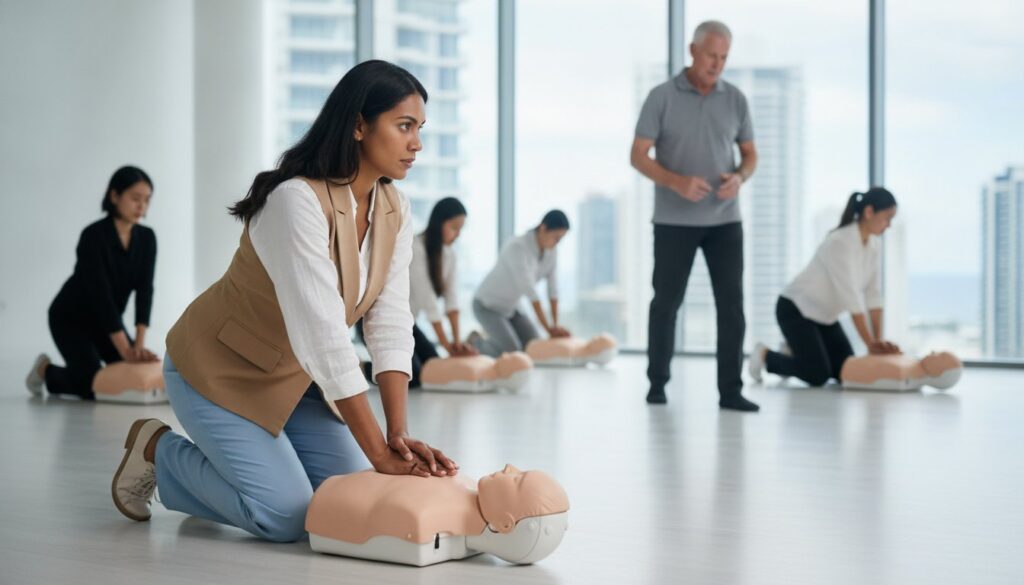
The core of the HLTAID009 assessment is the practical demonstration of chest compressions. To be deemed competent, you must perform at least two minutes of uninterrupted CPR on an adult manikin placed on the floor. This is a strict national assessment requirement designed to simulate a real-world emergency where you’d likely be kneeling beside a patient. If you have a temporary injury, such as a severe back or knee problem that prevents you from kneeling, you should wait until you’re fully recovered before booking your session. During the practical, you’ll demonstrate the full DRSABCD action plan, which requires physical movement and clear communication. Pregnant students or those with chronic health conditions are encouraged to participate, provided they feel comfortable performing the physical tasks required. If you’re unsure about your readiness, you can view our course requirements for more detail.
Finally, consider your attire. Since you’ll be spending a significant amount of time on the floor, wear comfortable trousers and closed-toe shoes. Avoid skirts, dresses, or restrictive clothing that might hinder your movement. Proper footwear is also essential for maintaining your balance while performing compressions. By checking off these items before you arrive, you ensure your CPR refresher Gold Coast experience is efficient, professional, and successful.
Choosing the Right CPR Course Format
Selecting the right delivery mode for your CPR refresher Gold Coast is essential for balancing your busy schedule with the need for high-quality practical training. While all formats must adhere to the official HLTAID009 unit requirements, the way you engage with the material can vary significantly. Whether you prefer a traditional classroom setting or a fast-tracked digital approach, understanding these options ensures you don’t waste time on repetitive theory you already know. Most comprehensive refresher sessions take between two and three hours to complete, depending on the format you’ve selected.
Standard face-to-face sessions are the traditional choice. These are ideal for students who prefer hands-on guidance from start to finish without the need for pre-course homework. In contrast, the Blended or Express format is often the preferred route for experienced “refresher” students. This model allows you to complete the theory modules online in your own time, meaning your time at the training centre is dedicated almost entirely to practical assessment. For those in high-level clinical roles who perform these tasks daily, assessment-only options may be available, though these are less common for the general public. If you’re based near the border and looking for nearby options, our CPR refresher Tweed Heads sessions offer the same nationally recognised HLTAID009 training with flexible scheduling to suit your needs.
Comparing Blended vs. Full Face-to-Face
The main trade-off between these formats is convenience versus immediate instructor access. Online theory modules offer the flexibility to learn at your own pace, which is a massive benefit for those with irregular work hours. However, beginners or those who haven’t refreshed their skills in several years should almost always choose the full face-to-face delivery mode. The Express model is specifically designed to focus on practical competency for returning students who are already familiar with the core concepts. It streamlines the process by assuming a baseline level of knowledge, allowing for a more efficient assessment day. If you’re looking to broaden your qualifications beyond CPR alone, a first aid course Coolangatta that combines HLTAID011 and CPR training is an efficient way to meet both requirements in a single session.
Group Training vs. Individual Bookings
For businesses or sports clubs, organising on-site group training is often the most practical solution. This allows a trainer to come to your location and customise the training scenarios to your specific industry. A gymnasium team might focus on cardiac arrest scenarios on a gym floor, while a construction crew might simulate an emergency in a high-risk work zone. Beyond the tailored experience, group bookings for teams of 10 or more are typically more cost-effective than individual enrolments. It’s an excellent way to ensure your entire staff stays compliant simultaneously while minimising workplace disruption.
Ultimately, your choice should reflect your confidence level and your professional requirements. Whether you book as an individual or part of a larger team, a CPR refresher Gold Coast session provides the necessary skills to act decisively in an emergency. By selecting a format that matches your learning style, you’ll walk away feeling more confident and fully compliant with national standards.
Assessment Day Checklist: Skills You Must Demonstrate
The practical assessment is the core of your CPR refresher Gold Coast. While theory provides the foundation, the assessment day is where you demonstrate your ability to act under pressure in a simulated emergency. Trainers look for physical competency and the ability to follow the national protocols established by the Australian Resuscitation Council. You’ll be guided through several scenarios, ensuring you can apply life-saving techniques to casualties of different ages while maintaining your own safety.
During the session, you must successfully demonstrate the following key skills:
- D.R.S.A.B.C.D. Protocol: Perform the full primary survey, from checking for danger to applying a defibrillator.
- Adult CPR: Complete at least two minutes of continuous chest compressions and rescue breaths on an adult manikin on the floor.
- Infant CPR: Demonstrate the correct two-finger compression technique and gentle rescue breaths on a baby manikin.
- AED Operation: Show how to correctly attach pads and follow the automated voice prompts of an Automated External Defibrillator.
- Incident Reporting: Practice a verbal handover to emergency services and understand how to complete a basic workplace incident report.
The Practical Performance Evidence
Precision is vital when performing compressions. To meet the national standard, you must achieve a compression depth of approximately one-third of the chest and maintain a steady rate of 100 to 120 beats per minute. This rhythm is essential for maintaining blood flow to vital organs. You’ll also practice using a pocket mask or face shield to deliver effective rescue breaths safely. The ‘Chain of Survival’ represents the critical sequence of actions that significantly increase the likelihood of survival following a cardiac arrest. Mastering these individual links ensures you provide the best possible chance for a casualty before paramedics arrive.
Managing the Unconscious Breathing Casualty
Not every emergency requires CPR. If a casualty is unconscious but breathing normally, you must demonstrate how to manage their airway and prevent further injury. This involves placing the person into the recovery position (also known as the lateral position) to keep the airway clear and stable. You’ll practice airway management techniques such as the head tilt and chin lift, which vary slightly depending on whether you’re treating an adult, child, or infant. Recognising normal breathing patterns and clearing obstructions are essential skills that ensure the casualty remains safe while help is on the way. To ensure you are fully prepared for these practical tasks, you can book your CPR refresher training today and practice with our experienced trainers.
By the end of the assessment, you should feel confident in your ability to respond to a cardiac arrest or airway emergency. The goal of a CPR refresher Gold Coast is to move beyond simple memorisation and build the muscle memory required for real-world application. This hands-on approach ensures that if you’re ever called upon to help, your response will be instinctive and effective.
Securing Your Nationally Recognised CPR Certification
Once you’ve successfully completed your practical assessment, the final step is receiving your official documentation. In 2026, the industry standard has shifted toward digital efficiency. Most professional providers now offer same-day issuance, meaning you’ll likely receive your digital certificate via email within hours of finishing your session. This speed is crucial for those needing to provide immediate proof of compliance to an employer or professional registration body. Having your paperwork sorted quickly means you can return to work with the confidence that your credentials are fully up to date.
Your certificate will be issued as a Statement of Attainment. It’s essential to check that it clearly lists ‘HLTAID009 Provide cardiopulmonary resuscitation’ as the unit of competency. This specific code confirms you’ve met the latest national standards for life-saving care. To verify your certificate’s authenticity, employers can often use a QR code or a unique certificate number provided by the training organisation. To stay ahead of the curve, set a calendar reminder for 11 months from your completion date. This gives you plenty of time to book your next CPR refresher Gold Coast session before your current one actually expires.
The Role of the RTO (Registered Training Organisation)
For your certification to be valid in any Australian workplace, the training must be delivered by or on behalf of a Registered Training Organisation (RTO). Coolangatta First Aid & CPR Training operates as a partner of ABC LicenceTraining (RTO 3399). Always look for the ‘Nationally Recognised Training’ logo on your certificate; it’s your guarantee that the qualification is accepted across all states and territories. Once your assessment is finalised, your results are uploaded to your national USI transcript. This creates a permanent, centralised record of your achievements that you can access whenever you need to prove your qualifications for a new job or professional audit.
Keeping Your Skills Current Between Refreshers
While your certificate is valid for a year, your skills shouldn’t sit idle until the next booking. You can stay sharp by accessing free online resources and checking for any ARC guideline updates throughout the year. Many workplaces also find value in regular ‘toolbox talks’ or quick practice sessions to keep the DRSABCD protocol fresh in everyone’s minds. These small, consistent efforts ensure that if an emergency does occur, your response is second nature. If you’re ready to renew your skills and stay compliant, you can book your CPR refresher Gold Coast session today and join a professional training environment designed for your success.
Maintain Your Life-Saving Edge in 2026
Staying current with your HLTAID009 certification is about more than just satisfying a workplace requirement; it’s about having the confidence to act when every second counts. By following this 2026 checklist, you’ve seen how straightforward it is to organise your USI, choose a flexible course format, and master the practical skills required for adult and infant resuscitation. Your skills are most effective when they’re fresh, which is why the annual update remains the industry benchmark for safety and compliance.
When you’re ready to complete your CPR refresher Gold Coast, our team provides Nationally Recognised Training as a proud Partner of ABC LicenceTraining (RTO 3399). You’ll learn from expert local trainers with real-world experience who prioritise practical competency over endless theory. Don’t let your certification lapse and leave you unprepared for a sudden emergency. Book Your HLTAID009 CPR Refresher Now and ensure you’re always ready to save a life. We look forward to seeing you at the training centre soon.
Frequently Asked Questions
How long does a CPR refresher course take in 2026?
A standard CPR refresher Gold Coast session typically takes between two and three hours to complete. This duration depends on the delivery format you choose; for instance, a blended learning model allows you to complete theory online beforehand, reducing your time at the training centre to approximately 90 minutes of practical assessment. Full face-to-face sessions cover both theory and practical components in a single block, ensuring you meet all national competency standards efficiently.
Is the HLTAID009 certificate valid for 1 or 3 years?
The HLTAID009 Statement of Attainment is technically valid for three years, but the Australian Resuscitation Council (ARC) guidelines recommend that CPR skills be refreshed every 12 months. Most Australian workplaces and regulatory bodies, including AHPRA and various WHS codes, mandate this annual update to ensure life-saving techniques remain current. While a broader first aid qualification like HLTAID011 lasts three years, the specific CPR component requires this yearly check-up to maintain compliance.
Do I have to perform CPR on the floor to pass the assessment?
Yes, performing uninterrupted CPR on an adult manikin placed on the floor is a mandatory requirement of the national assessment. To be deemed competent, you must demonstrate at least two minutes of continuous chest compressions and rescue breaths. This simulates a real-world emergency where a casualty is likely to be on the ground. If you have a physical condition or injury that prevents you from kneeling, it is best to delay your booking until you are recovered.
Can I do my CPR refresher entirely online?
No, you cannot complete a nationally recognised CPR certificate entirely online. While theory modules can be finished via a digital portal, the Australian government requires a face-to-face practical assessment to verify your competency. You must physically demonstrate your ability to perform compressions and use an Automated External Defibrillator (AED) under the supervision of a qualified trainer. This ensures that your hands-on skills meet the rigorous standards necessary for actual emergency situations.
What happens if my CPR certificate has already expired?
If your certificate has expired, you simply need to enrol in a new HLTAID009 course to regain your qualification. There is no formal “grace period” that allows you to use an expired certificate for workplace compliance. Because the training and assessment requirements for a refresher are identical to the initial course, you won’t be penalised for the lapse. However, staying on top of your annual renewals ensures you never find yourself unqualified during a workplace audit.
Is HLTAID009 the same as the old HLTAID001 course?
HLTAID009 is the current nationally recognised unit of competency that has superseded the older HLTAID001 code. While the core principles of cardiopulmonary resuscitation remain similar, the updated unit incorporates the latest 2026 protocols from the Australian Resuscitation Council. These updates often focus on improved compression techniques and the integration of modern AED technology. When booking your CPR refresher Gold Coast, always ensure the training provider is delivering the HLTAID009 unit to ensure your qualification is valid.
What should I bring to my CPR training day?
You must bring a valid form of Australian identification, such as a driver’s licence or passport, and your Unique Student Identifier (USI). Without these, your trainer cannot verify your identity or issue your Statement of Attainment. It’s also important to wear comfortable, modest clothing and closed-toe shoes, as you will be kneeling on the floor for the practical assessment. Bringing a pen and a bottle of water is also recommended for your comfort during the session.
Will I get my CPR certificate on the same day as the course?
Most students receive their digital Statement of Attainment within hours of successfully completing their assessment. As a partner of ABC LicenceTraining (RTO 3399), we prioritise fast-tracked processing to ensure you stay compliant without unnecessary delays. Once your trainer confirms your practical competency and your USI is verified, the digital certificate is generated and sent directly to your email. This allows you to provide immediate proof of your updated qualification to your employer or professional body.
