
Why does one HLTAID009 certificate cost double the price of another when they both claim to meet the same Australian national standard? It’s a common frustration when you’re trying to calculate the CPR course cost Gold Coast workers might face, especially when you need a valid qualification for work without wasting your entire Saturday. You’ve likely seen a confusing array of course codes and prices, leaving you wondering if a cheaper option means sacrificing accreditation or quality.
This guide helps you sort through these variables by breaking down the factors that influence training prices across Australia in 2026. We’ll help you distinguish between budget-rate shortcuts and genuine, accredited value, ensuring you receive a nationally recognised HLTAID009 certification. You’ll learn how to identify providers who balance competitive rates with high-quality, efficient delivery methods like blended learning.
We’ll explore why some delivery methods save you precious time, how to verify that your trainer aligns with the latest Australian Resuscitation Council guidelines, and what to look for to ensure your certificate is valid for your specific industry. By the end, you’ll know exactly how to find the best value for your 2026 refresher while meeting all compliance requirements.
Key Takeaways
- Identify the HLTAID009 unit as the essential national standard to ensure your certification is legally valid for Australian workplaces.
- Understand how the CPR course cost Gold Coast providers offer is influenced by overheads like high-quality manikin maintenance and professional venue hire.
- Save money and time by choosing blended learning delivery, which allows you to complete theory online before a short practical assessment.
- Use our verification steps to check a provider’s RTO status, ensuring you don’t pay for a certificate that won’t be recognised by your employer.
- Balance the reliability of national accreditation with the personalised care of a family-run business when booking your next refresher.
What Factors Influence the CPR Course Cost Across Australia?
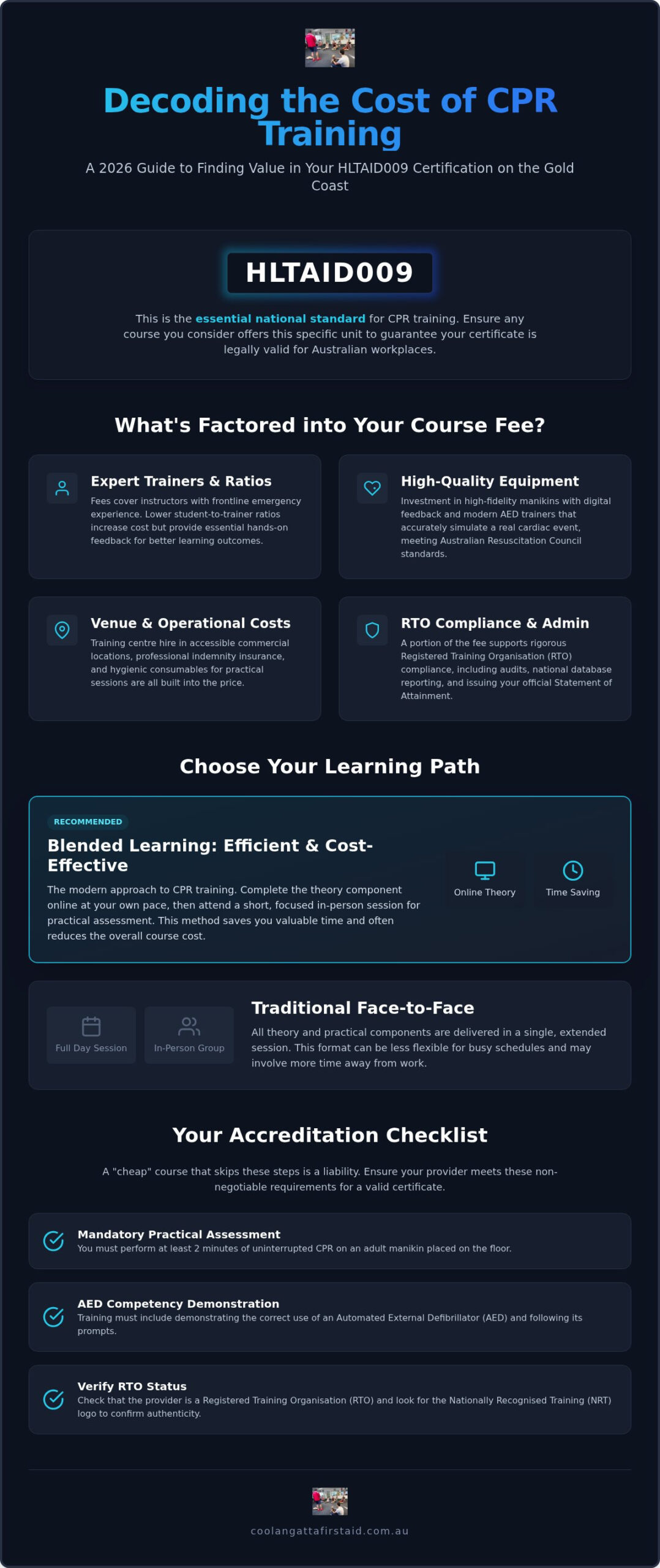
Calculating the CPR course cost Gold Coast professionals encounter involves a blend of operational overheads, equipment maintenance, and strict regulatory compliance. A standard fee typically covers the hire of a suitable training venue, professional indemnity insurance, and the specialised consumables required for a hygienic practical session. The delivery of Cardiopulmonary resuscitation (CPR) training also necessitates high-quality gear that must be regularly tested and updated to remain effective.
Venue location plays a major role in pricing. Training centres situated in accessible commercial hubs often face higher rent and utility costs, which are factored into the individual seat price. Trainer-to-student ratios also significantly influence both the price and the learning outcome. A lower ratio ensures each participant gets hands-on feedback, though it naturally increases the per-person fee to cover the instructor’s expertise. Conversely, bulk corporate bookings often allow organisations to reduce the per-head cost by hosting the session at their own premises, which removes the provider’s venue overheads and allows for more competitive group rates.
Trainer Expertise and Equipment Quality
Using high-fidelity manikins that provide digital feedback on compression depth is a hallmark of quality training. These tools are vital for ensuring you meet the Australian Resuscitation Council (ARC) standards for effective life-saving techniques. When you choose a provider that invests in advanced AED trainers and employs instructors with frontline emergency experience, you aren’t just paying for a piece of paper. You’re investing in the confidence that you can perform under pressure, backed by equipment that accurately simulates a real cardiac event.
Administrative and RTO Compliance Fees
A portion of your course fee supports the rigorous administrative requirements of the Australian vocational education sector. Registered Training Organisations (RTOs) must manage ongoing compliance, including regular audits and the secure reporting of results to the national training database. Issuing a nationally recognised Statement of Attainment for HLTAID009 involves specific licensing fees and administrative labour. These costs ensure that your certification is legally defensible and recognised by employers across every state and territory, preventing the wasted expense of non-accredited sessions that don’t meet workplace safety standards.
Accreditation vs Price: Understanding the HLTAID009 Standard
When you’re comparing the CPR course cost Gold Coast providers list, it’s easy to get distracted by the bottom line. However, the most critical factor isn’t the dollar amount, but whether the course adheres to the official HLTAID009 standard. HLTAID009 Provide cardiopulmonary resuscitation is the current nationally recognised unit of competency required for workplace compliance across Australia. Even if you find a budget-friendly option, the training must still meet rigorous assessment criteria to be valid. A “cheap” course that skips essential practical steps isn’t a bargain; it’s a liability that won’t be recognised by your employer or insurance provider.
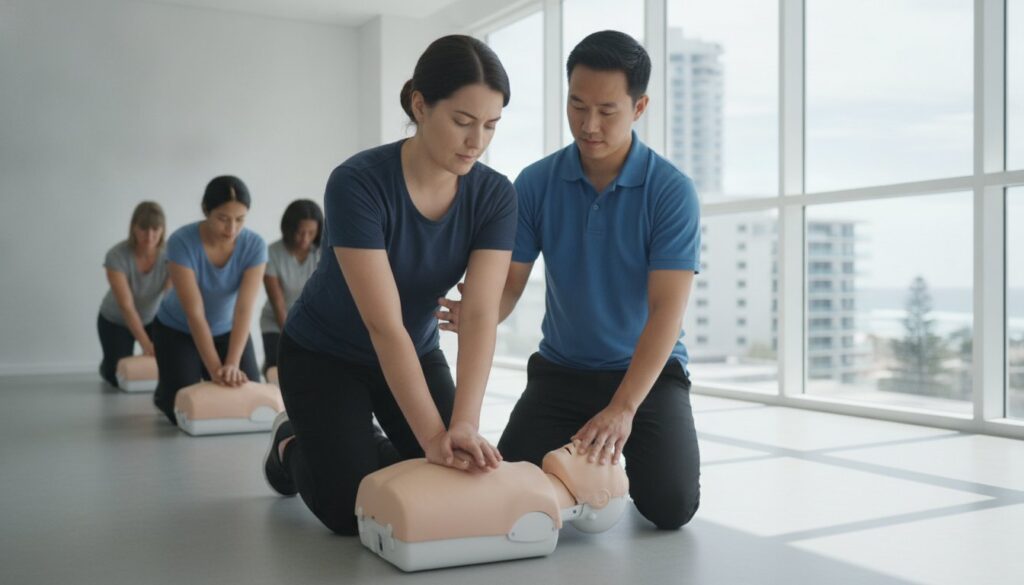
Every accredited HLTAID009 course requires participants to demonstrate their skills through a practical assessment. This includes performing at least two minutes of uninterrupted CPR on an adult manikin placed on the floor. You’ll also need to demonstrate the correct use of an Automated External Defibrillator (AED) and follow the prompts of a trainer. Non-accredited “awareness” sessions might be cheaper because they omit these formal assessments, but they don’t provide the legal certification needed for professional roles. If you’re unsure which level of training your industry requires, you can consult our national certification guide for a clear breakdown of workplace expectations.
Nationally Recognised Training (NRT) Requirements
To ensure your CPR course cost Gold Coast investment is worthwhile, always look for the Nationally Recognised Training (NRT) logo. This symbol confirms the provider is either a Registered Training Organisation (RTO) or an authorised third-party partner. There’s a significant difference between a generic “CPR certificate” and an accredited unit of competency. An accredited unit is recorded on your national training transcript, providing a permanent record of your skills that carries weight in every state. Choosing a reputable provider like Coolangatta First Aid ensures your certificate meets these stringent national standards without unnecessary administrative hurdles.
The Role of the Australian Resuscitation Council (ARC)
The technical content of your training isn’t decided by the provider; it’s dictated by the Australian Resuscitation Council (ARC). These guidelines are updated based on the latest medical research to ensure life-saving techniques are as effective as possible. Because these protocols evolve, the ARC recommends that CPR qualifications be renewed every 12 months. As the ARC states, “High-quality, early CPR is the most significant factor in surviving a sudden cardiac arrest.” Adhering to this annual renewal cycle ensures your skills remain sharp and your techniques align with the most current life-saving evidence available in 2026.
The Real Value of Blended Learning vs Traditional Face-to-Face
Choosing between a full day in a classroom and a modern blended model is about more than just convenience. It’s a strategic decision that affects the total CPR course cost Gold Coast professionals must account for when managing their schedules. While traditional face-to-face sessions require a significant block of time away from the workplace, blended learning splits the requirement into two distinct phases. This shift doesn’t just lower the barrier to entry; it often results in better skill retention by separating theoretical knowledge from physical practice.
The financial impact of training extends beyond the initial booking fee. For many, the “true” cost includes hours of lost productivity or the need to find staff cover. Blended learning addresses this by moving the lecture-style components into a digital environment. Importantly, the final Statement of Attainment is identical regardless of the delivery method. Whether you spend eight hours in a room or complete your theory at home, you still meet the same HLTAID009 national training standard required for Australian workplace compliance.
Time-Saving Benefits of Online Pre-Learning
Online pre-learning allows participants to work through the cognitive elements of CPR at their own pace. You can pause, rewind, and review complex topics like the physiology of cardiac arrest or the legalities of duty of care without feeling rushed by a group. This model is particularly effective for busy Gold Coast workers who can finish their modules during a commute or after hours. By the time you arrive for your practical session, you’ve already passed the theoretical assessments, allowing the instructor to focus entirely on your life-saving technique.
Practical Assessment and Hands-On Skill Mastery
Despite the flexibility of online theory, the practical assessment remains a non-negotiable, in-person requirement for HLTAID009. These focused sessions typically last between one and three hours, depending on the group size and the provider’s efficiency. During this time, you’ll demonstrate mastery of essential skills, including:
- Correct placement and operation of an Automated External Defibrillator (AED).
- Performing at least two minutes of uninterrupted chest compressions on an adult manikin.
- Managing an unconscious, breathing casualty by placing them in the recovery position.
- Effective rescue breathing and airway management techniques.
Because these sessions are shorter and more intensive than traditional all-day courses, participants often find they are more engaged. You don’t have to sit through hours of slides before touching a manikin. Instead, the “hands-on” time is prioritised, ensuring that the physical muscle memory required for an emergency is properly developed and tested.
How to Evaluate a Training Provider Beyond the Price Tag
Finding a low CPR course cost Gold Coast workers can afford is only the first step in your search. While a bargain price is attractive, the true value of your training lies in its accreditation and the quality of the instruction you receive. A cheap certificate that isn’t recognised by your employer is a waste of money. To ensure you’re making a sound investment, you must look past the marketing headlines and evaluate the provider’s operational standards and compliance record.
Start by confirming the specific unit code being offered. You are looking for HLTAID009 Provide cardiopulmonary resuscitation. Some providers might use generic titles like “Basic Life Support” or “CPR Awareness” to lower their prices, but these often lack the national recognition required for workplace safety roles. You should also check independent reviews for feedback on trainer support and equipment hygiene. High-quality training centres maintain their manikins to strict standards and provide enough equipment so that you aren’t waiting around for your turn to practice.
Practical assessment requirements are another non-negotiable factor. To meet the national standard, you must perform CPR on an adult manikin placed on the floor for at least two minutes. If a provider suggests you can complete the assessment on a table or skip the physical component, their certification is likely invalid. Finally, confirm the turnaround time for your certificate. In a competitive market, you should expect your Statement of Attainment to be issued promptly after successful completion, ensuring you don’t miss important workplace deadlines.
Checking RTO Registration and Course Validity
You can verify any training provider by searching the training.gov.au database. This official register lists every Registered Training Organisation (RTO) and their current scope of registration. It’s common for local businesses to operate as authorised third-party partners for a larger RTO. For example, Coolangatta First Aid & CPR Training operates as a third-party provider for RTO 3399. This partnership allows you to receive personalised, family-run service while maintaining the high accredited standards of a national organisation. If you are renewing your qualification, use our CPR refresher checklist to ensure your chosen provider meets all 2026 requirements.
Hidden Costs and Transparency in Booking
When comparing the CPR course cost Gold Coast providers advertise, watch out for hidden extras that can inflate the final price. Some companies charge additional fees for physical manuals, “re-issue” fees if you lose your digital certificate, or processing charges for weekend sessions. A transparent provider will offer an all-inclusive booking fee that covers your online theory access, practical training, and the issuance of your nationally recognised certificate. While price-match guarantees are common, always scrutinise them to ensure you are comparing like-for-like quality. If you want a straightforward booking experience with no hidden surprises, you can book your accredited CPR training through our secure online system today.
Quality CPR Training with Coolangatta First Aid & CPR
Choosing a training provider involves balancing the need for professional accreditation with the desire for a supportive, personalised learning environment. Coolangatta First Aid & CPR Training operates as a family-run business, bringing a dedicated, helpful approach to every session. While the CPR course cost Gold Coast professionals encounter can vary, our focus remains on providing genuine value through high-quality instruction and efficient delivery. We specialise in delivering the most in-demand units, including HLTAID009 Provide cardiopulmonary resuscitation and HLTAID011 Provide First Aid, ensuring your certification is both relevant and compliant.
Our status as a third-party provider for ABC LicenceTraining (RTO 3399) means you receive the best of both worlds. You benefit from the agility and care of a local, family-operated centre while receiving a Statement of Attainment backed by a major Registered Training Organisation. This partnership ensures that every course we deliver meets the rigorous standards set by the Australian Skills Quality Authority (ASQA) and aligns perfectly with the latest ARC guidelines. Whether you are a solo learner or managing a large team, this accredited framework guarantees your qualification is recognised by employers and regulatory bodies across the country.
Nationally Accredited HLTAID009 Training
We take a student-centric approach to both practical assessments and theoretical components. Our trainers understand that while the CPR course cost Gold Coast workers pay is an investment, your time is equally valuable. By utilising a blended learning model, we allow you to engage with the theory in a way that suits your schedule, leaving our face-to-face time for hands-on skill mastery. This method is particularly effective for those in high-stakes environments who need to feel confident in their physical life-saving techniques. We also provide specialised support for various sectors, such as educators and carers who require a childcare first aid qualification like HLTAID012.
Workplace and Group Training Solutions
For businesses looking to train multiple staff members, we offer flexible group training solutions that can be delivered onsite at your premises. This approach is often more cost-effective for organisations as it eliminates travel time for staff and allows us to tailor the training to your specific workplace hazards. Whether you work in construction, healthcare, or corporate services, we can customise the practical scenarios to reflect the real-world risks your team might face. This ensures that the training isn’t just a compliance exercise, but a practical safety upgrade for your entire workforce. You can view upcoming course dates and options on our website to find a session that fits your operational needs.
Secure Your Life-Saving Skills for 2026
Finding the right CPR course cost Gold Coast professionals can trust means looking beyond the cheapest sticker price. True value comes from a nationally recognised HLTAID009 certification that your employer will actually accept. By choosing a blended learning model, you don’t just save time; you ensure your training is efficient and focused on the practical skills that save lives. Remember to always verify a provider’s RTO status to avoid wasting money on non-accredited awareness sessions that don’t meet Australian workplace standards.
At Coolangatta First Aid & CPR Training, we combine the reliability of Nationally Recognised Training via RTO 3399 with the personalised service of a family-run business. Our experienced trainers bring real-world clinical knowledge to every session, ensuring you walk away with the confidence to act in an emergency. Whether you’re a healthcare professional or a local business owner, we’re committed to your success and safety.
Book your HLTAID009 CPR course with our expert team today and stay compliant with the latest ARC guidelines. Taking the time to refresh your skills now ensures you’re prepared for whatever challenges the year ahead may bring.
Frequently Asked Questions
Is the HLTAID009 certificate valid for all Australian workplaces?
Yes, the HLTAID009 certificate is the nationally recognised standard for CPR in Australia. It is accepted by employers in every state and territory. This certification ensures you meet the vocational training requirements for workplace health and safety compliance. While it covers the essentials of life support, some specialised industries may require additional units, such as HLTAID012 for childcare or UETDRMP018 for electrical work, depending on the specific hazards of your role.
How often do I need to renew my CPR certification?
The Australian Resuscitation Council (ARC) recommends that you renew your CPR certification every 12 months. This annual refresher ensures your life-saving skills remain current and your techniques align with the latest medical research. While your Statement of Attainment doesn’t technically expire, most Australian workplaces and professional bodies mandate a yearly update to maintain compliance. Regular training helps you stay confident in your ability to perform effective chest compressions and use an AED.
Can I do a CPR course entirely online for a lower cost?
No, you cannot complete a nationally recognised HLTAID009 course entirely online. While blended learning allows you to finish the theoretical components digitally, Australian national standards require a face-to-face practical assessment. You must demonstrate your ability to perform at least two minutes of uninterrupted CPR on an adult manikin placed on the floor. Any provider offering a 100% online certificate for a lower price is likely issuing a non-accredited awareness certificate that won’t meet workplace requirements.
What is the difference between HLTAID001 and HLTAID009?
HLTAID009 is the current nationally recognised unit of competency for cardiopulmonary resuscitation, replacing the older HLTAID001 code. When you are comparing the CPR course cost Gold Coast providers offer, ensure you are booking the modern HLTAID009 standard. The updated unit includes a stronger focus on the correct use of an Automated External Defibrillator (AED) and reflects the most recent clinical guidelines. Using the correct unit code ensures your qualification is valid for contemporary workplace safety audits.
Why do some CPR courses cost significantly more than others?
Price variations usually reflect the quality of the training environment and the expertise of the instructors. Higher-cost courses often invest in high-fidelity manikins with digital feedback and AED trainers that simulate real-world emergencies. These providers also cover the administrative costs of maintaining registration as an RTO or a compliant third-party partner. A lower CPR course cost Gold Coast workers might find could indicate larger class sizes, generic equipment, or a lack of personalised feedback during the practical assessment.
Do I need a USI (Unique Student Identifier) to enrol in a CPR course?
Yes, every student undertaking nationally recognised training in Australia must have a Unique Student Identifier (USI). This is a government-issued reference number that creates a secure online record of all your recognised training and qualifications. You cannot receive your Statement of Attainment for HLTAID009 without providing a valid USI to your training provider. It is a free number that you can easily create or find on the official government USI website before your course begins.
Will my CPR certificate be recognised if I move to a different state?
Yes, because HLTAID009 is a nationally recognised unit of competency, your certificate is valid in every Australian state and territory. Whether you move from Queensland to Western Australia or Victoria, your qualification carries the same weight with employers and regulatory bodies. The training follows a consistent national curriculum, ensuring that the life-saving techniques you learn are the standard protocols used by emergency services and workplaces across the entire country, regardless of your location.
What happens if I fail the practical assessment?
Our trainers are committed to your success and will provide guidance if you struggle with a specific technique. If you cannot demonstrate competency during the initial practical assessment, you’ll usually be given the opportunity to receive further instruction and attempt the task again. The goal of the assessment is to ensure you can safely and effectively perform CPR in a real-world scenario. Most students find that the hands-on practice provided during the session is sufficient to meet the required standards.
